New Control Engineering research shows that while implementation is ramping up, engineers remain cautious, prioritizing proven use cases like predictive maintenance over the AI hype cycle.
Industrial AI insights
- Most organizations are moving beyond AI curiosity and into active testing, but full production remains limited.
- Engineers view AI as a supportive layer for tasks like predictive maintenance rather than a replacement for core automation.
- Skepticism and cybersecurity risks are the primary barriers, making small-scale pilots essential for proving value.
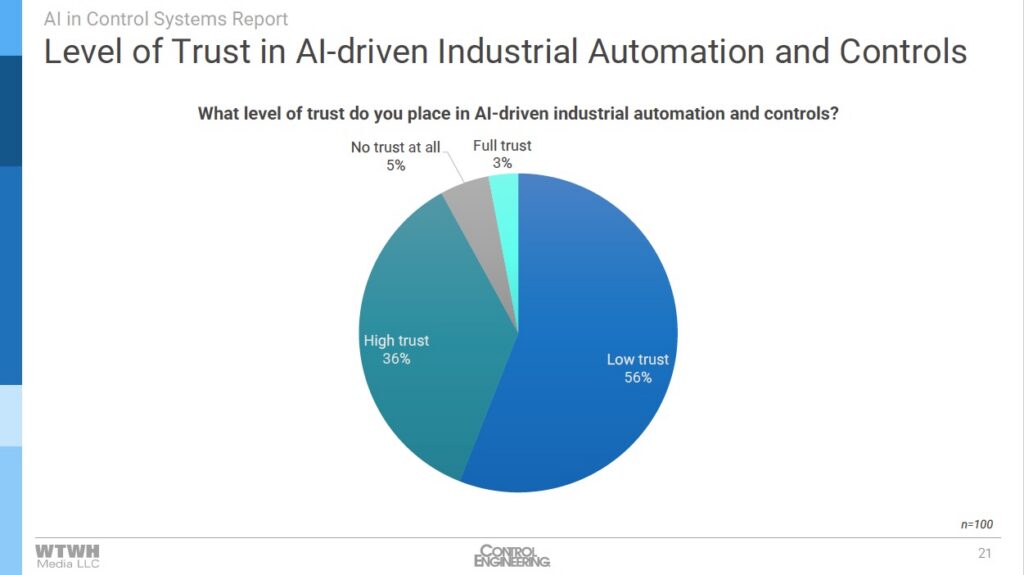
There is a tension at the center of industrial AI adoption: 65% of organizations are piloting or evaluating artificial intelligence (AI) and machine learning (ML) for automation and controls, yet 61% of professionals report low or no trust in AI-driven control systems.
That trust gap is shaping the next phase of adoption. AI can generate attention, but can it earn a place in environments where uptime, cybersecurity and safe, repeatable performance matter more than novelty?
Control Engineering‘s 2026 AI in Control Systems Report, based on responses from 107 professionals involved in specifying or purchasing control systems, shows an industry shifting from broad interest to targeted experimentation. Only 27% said AI or ML is in full production today, but pilots and proof-of-concept projects are widespread, showing manufacturers are looking for practical opportunities rather than waiting on the sidelines.
The full report is available at www.controleng.com/research.
Start with a problem worth solving
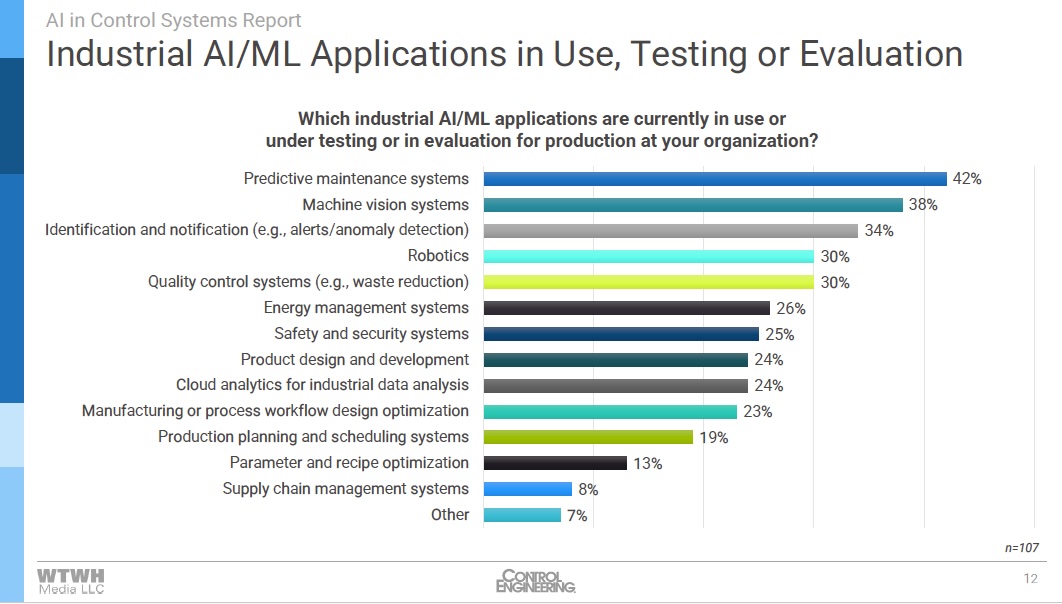
Predictive maintenance leads the list of AI/ML uses being deployed, tested or evaluated, followed by machine vision. Anomaly detection, robotics and quality-control applications are also attracting attention.
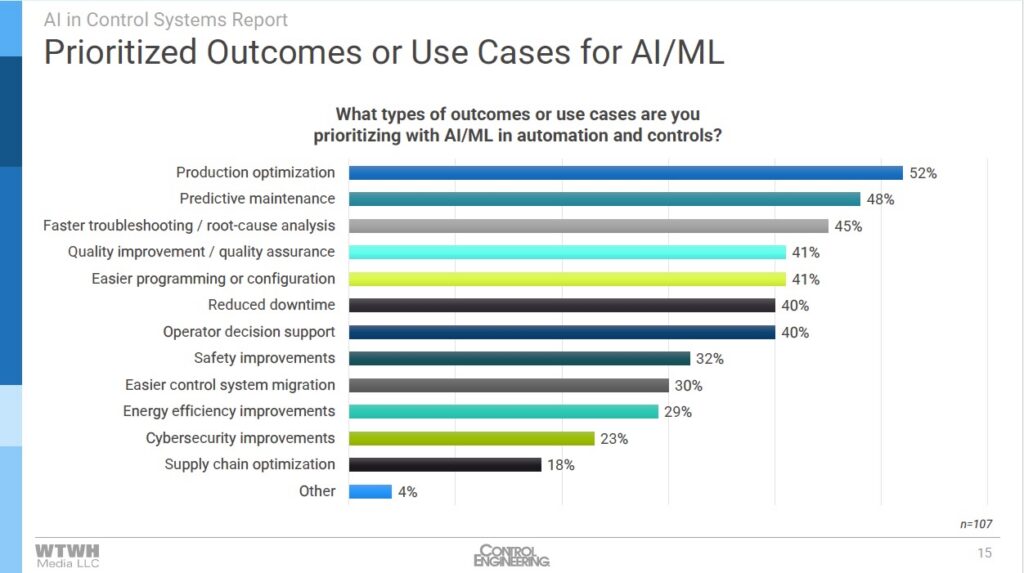
Industrial teams are applying AI/ML where it may help recognize developing equipment problems, identify production abnormalities or extract useful signals from growing volumes of plant data. Production optimization was the most frequently cited desired outcome, with predictive maintenance and faster troubleshooting following closely. These are familiar operational goals rooted in improving throughput, preventing unplanned downtime and finding the cause of a problem before it grows.
The case for AI augmentation
Despite the rhetoric surrounding AI, survey respondents do not expect it to displace the automation technologies already running their operations. Four out of five said AI/ML will complement traditional approaches rather than replace them.
The likely near-term model is an additional capability layer that supports engineers with earlier warnings, richer context and better-informed decisions. AI’s value lies in extending traditional control logic and safety systems, particularly where patterns are too complex, data sets too large or troubleshooting takes too long.
Technology needs proof before scale
Still, AI faces a higher bar than many other digital tools. Cybersecurity emerged as the leading adoption concern, with data collection and use and return on investment following behind. Pilot projects are the leading strategy for building trust and quantifying results. A narrowly focused deployment can show whether an AI model improves maintenance planning or reduces investigation time without introducing unnecessary risk.
Hybrid architectures combining on-premises and cloud-based models were the most popular deployment choice, while a substantial share of respondents favored on-premises-only systems.
Industrial AI is advancing, but its progress must be earned through secure deployments, transparent results and applications that make control systems — and the people responsible for them — more effective.
AI in control systems: By the numbers
27% — Organizations using AI/ML in full production
65% — Organizations piloting or evaluating AI/ML
42% — Cite predictive maintenance as a leading application
52% — Identify production optimization as a desired outcome
61% — Report low or no trust in AI-driven controls
80% — Say AI will complement, rather than replace, traditional automation
57% — Cite cybersecurity as a top AI adoption concern
54% — Use pilots to build trust and quantify ROI
LEARNING OBJECTIVES
- Recognize the industry shift from AI curiosity to practical pilot programs and proofs-of-concept.
- Pinpoint top-performing use cases like predictive maintenance, machine vision and production optimization.
- Address the trust gap and cybersecurity risks by using pilot-led benchmarks and hybrid deployment models.
CONSIDER THIS
How can we structure a pilot project that moves beyond a software demo to provide proof of ROI and cybersecurity compliance for our specific control environment?
YOU MIGHT ALSO LIKE
Research: Engineering career advice from 2026 salary survey respondents
7 pieces of advice from automation experts on AI, edge computing