Survey respondents to the 2026 Control Engineering Career and Salary Survey provided practical career advice. One survey question asked what skills are most needed to get ahead.
Control engineering career advice insights
- The 2026 Control Engineering Career and Salary Survey asked subscribers for advice on careers.
- Write-in answers covered automation leadership, better software and technology training.
- Other advice suggested continuing automation education and advancing process knowledge.
In the survey to collect data for the 2026 Career and Salary Research, Control Engineering asked subscribers for advice about skills needed to get ahead in your areas of responsibility today, including how and why; 86 offered advice in optional write-in questions. See the full report at www.controleng.com/research.
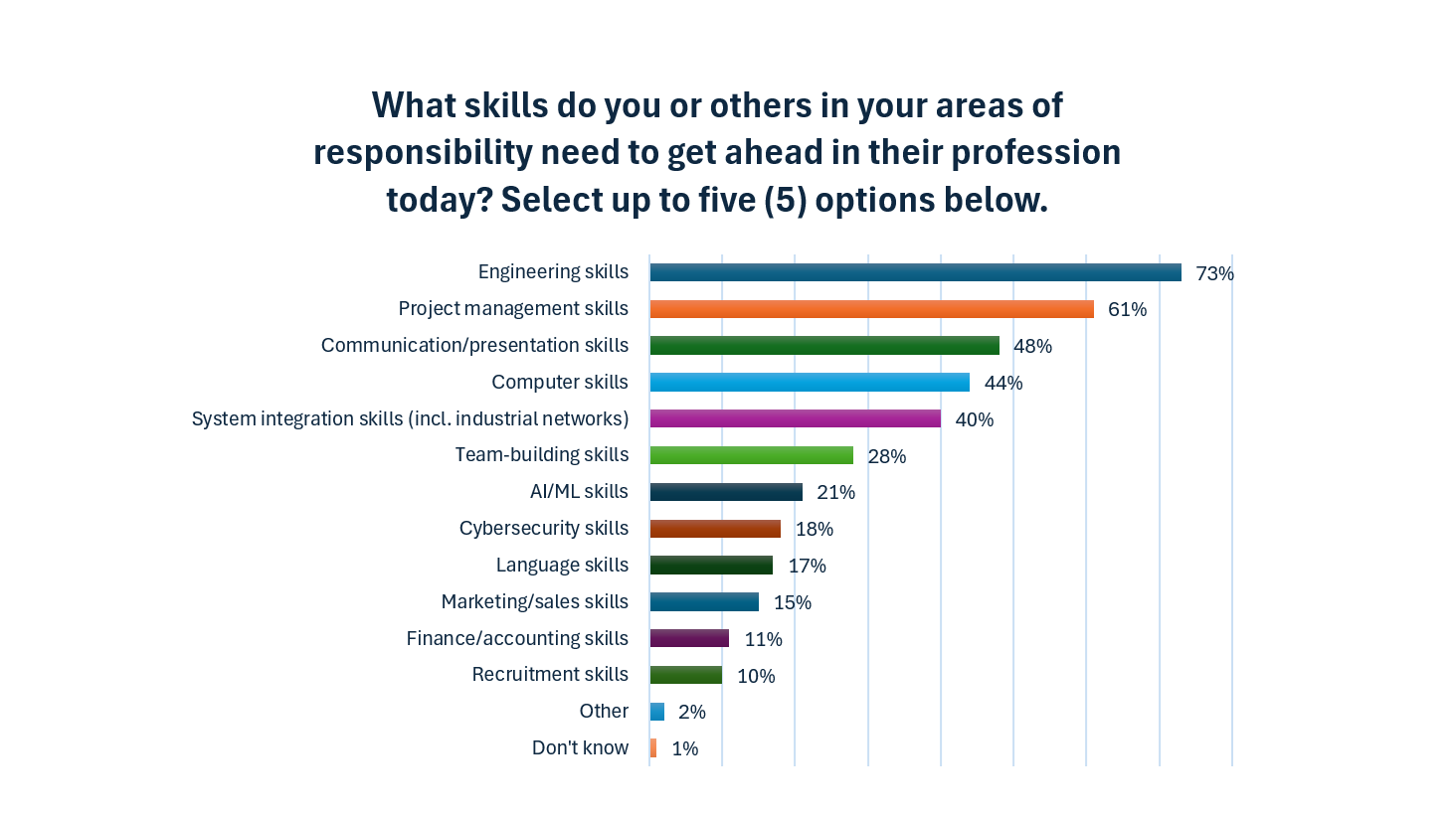
A question about leading skills needed to get ahead in the control engineering professions listed engineering, project management, communication, computer, and system integration skills among the top five (Figure 1), according to the 2026 Control Engineering Career and Salary Survey.
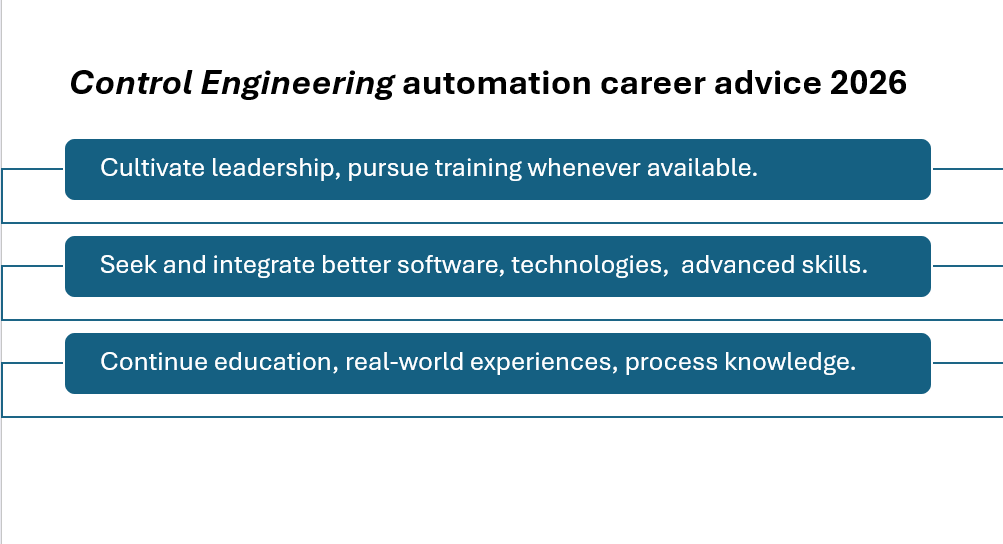
A sampling of automation engineering career advice (Figure 2) follows. Answers were edited for style and length with the intent on keeping original meaning.
Leadership, training, better software
Organizational leadership development is sorely missing, as is performing the role of a supervisor and talent development.
Two-way artificial intelligence (AI) for programming is needed to help translate a functional description into programmable logic controller (PLC) and distributed control system (DCS) code and translating PLC and DCS code into a functional description.
Vibration analysis certification helps machinery vibration analysts. Enroll through recognized bodies, such as Mobius Institute, SKF or Pruftechnik Academy. Cat I takes about three days; Cat II adds another 3 to 5 days. Certificates provide an added advantage beyond personal experiences.
Lube oil and tribology: An ICML MLT-I (Machine Lubrication Technician Level I) or MLA-I (Machine Lubrication Analyst Level I) certification from the International Council for Machinery Lubrication takes approximately 3 to 4 months of part-time study. On-the-job lube oil healthiness monitoring is possible, but most rotating equipment engineers cannot read an oil analysis report confidently. A formal tribology credential adds expertise to condition monitoring roles seeking to integrate predictive programs.
Reliability engineering fundamentals can build knowledge in reliability centered maintenance (RCM), failure mode and effects analysis (FMEA), risk-based inspection (RBI), and MTBF/MTTR analysis with training from engineering societies, institutes and associations. Most engineering roles seek strategic engineering functions, beyond hands-on technician activities.
Knowing how to use industrial analytics, advanced process controls, predictive maintenance can help; many software vendors offer free online learning.
Sharpen technical report writing skills and knowledge of standards and codes, such as API 670 — Machinery Protection Systems API 678 — Accelerometer-Based Vibration Monitoring ISO 10816 / ISO 20816 — Vibration severity standards API 580/581 — Risk-Based Inspection ISO 55000 — Asset Management. Purchase or download standards through API or ISO. Join ASME, SPE, or IMechE — member access often includes reduced-cost standards. This helps recommend vibration alarm limits, propose a monitoring program or challenge an original equipment manufacturer’s (OEM) recommendation.
Automation areas, technologies, skills
Real life is rarely “fair.” Someone always does more. Get used to it now, and you will be a better employee.
Be a sponge; take advantage of every training opportunity presented. Real-world experience must be part of training. The classroom will only get you so far. Open your mind to new technologies with a focus on process improvement.
Cross network (IT/OT) skills are needed to prevent IT from implementing dangerous software and restricting access to control networks. Cybersecurity skills are needed to prevent access and ensure data flow to the correct operations. Knowledge of multiple control software systems allows system integration without relying on experts that do not know software other than their own.
Why continuing education is important
Education is at the forefront of every position. You can always learn more. Stay current/up to date with what is new.
Find out what you don’t know. When troubleshooting, apply systems thinking while working on parts of the system. Continue education by upgrading your skillset. Be aggressively curious.
Get as much experience as one can early in life in one or more areas that interest you. This will give you a passion for something and prepare you for a career that will keep your interest for many years.
One of the biggest required skills is root-cause analysis. This skill is needed to troubleshoot equipment issues, as well as determine the root cause of product failures and issues.
Routine, preventive maintenance and emergency procedures in the modern age. How can companies protect themselves from being cyber-victims?
Technical proficiency is needed in system integration, data analytics, quality standards, project management and vision systems with education and training, hands-on experience, continuous learning and networking. This helps efficiency and productivity, quality assurance, innovation and problem-solving.
The need to better understand and apply artificial intelligence in all facets is becoming paramount. Obtaining those skills is the best path to staying ahead in the market.
Automation, controls experiences
To get ahead in Instrumentation and control within process and power industries, a balanced mix of technical depth and managerial capability is essential. Strong expertise in DCS, PLC and safety instrumented systems (SIS) is fundamental, as modern plants rely heavily on automation for safe and efficient operations. Knowledge of functional safety standards (IEC 61508/61511) and involvement in activities like SIL studies and PSSR ensures compliance and risk reduction. Project management skills are equally important—planning, scheduling, cost control and vendor coordination directly impact timely and successful project execution. Familiarity with engineering, procurement and construction (EPC) environments and software adds significant value. With the rise of Industry 4.0, data analytics and digitalization skills (industrial internet of things [IIoT], predictive maintenance, smart instrumentation) are becoming critical to improve reliability and optimize performance. Effective troubleshooting and root cause analysis (RCA) help minimize downtime and production losses. Strong communication and stakeholder management skills enable smooth coordination across operations, maintenance and external vendors. Finally, leadership and team development capabilities are key for career growth, as roles increasingly demand mentoring, decision-making and accountability. Overall, combining technical expertise, digital awareness and leadership skills ensure better plant performance, safety and progression into senior roles.
Data-driven decisions; process knowledge
To get ahead in my areas of responsibility, several skills are important. Strong data analysis and diagnostic skills help identify issues quickly and support data-driven decisions. Expertise in automation and control systems improves system reliability and troubleshooting efficiency. Clear cross-functional communication and a commitment to continuous learning are essential to adapt to new technologies and collaborate effectively across teams.
Understand the process you are trying to control. Get to know the people in the plants and what they do, especially for those that work remotely.
Remain curious and actively seek how things work and why alternatives were not chosen. This approach can help one discover what they didn’t know that they didn’t know.
Advanced computer-aided design (CAD) software knowledge helps. I am a controls engineer, but people must do EVERYTHING today, including high-level programming and networking.
Gather AI knowledge of what is required for the liquid cooling systems being implemented in data centers and changes to the HVAC systems going from air cooled to liquid cooled.
Be willing to try anything but do so before releasing to production. Failure is only temporary and is one of the best learning experiences.
First, read everything you can get your hands on about your job, your industry, specifications and other areas. Then, listen to what people are saying and ask questions for better understanding.
Hit the ground and learn while doing. You can learn many things by reading but seeing how what you do affects the systems is extremely important.
Keep up to date on technologies and innovations. Teamwork, professional responsibility and shared responsibilities are important to achieve high quality control. Skills and attitude are the top priority
Learn skills to stay up to date with new technologies. Admit when you don’t know something; don’t be afraid to ask for help.
New graduates have a distorted view of what engineering is and have unrealistic expectations of what they should be responsible for.
Sharpen your technical skills and ensure your soft skills, especially team leadership and communication, are always improving.
Smart dust-based MEMS-controlled devices have an extended range of operation, monitoring and diagnostic capability in industrial applications.
Skills in your areas, AI integration
Advanced software helps in the electrical design and construction of data centers.
Agentic AI will help some but has a way to go. It would help to have two-way HMI integration with AI agents and analytics tools for process optimization, on one pane of glass for the control system with a copilot / expert agent for the operator. Adding efficiency and effectiveness to executing projects / supporting operations remotely will help, hopefully without layering something additional on top of the existing tech stack.
AI is accelerating and improving the preparatory work necessary for field implementation, substituting, product catalogs and instruction manuals
AI is a threat and a tool.
AI will not help you learn. Learning requires consistent commitment to bettering yourself for the service of your customers and company.
AI is said to be the future for a lot of companies. Learning how it works and how to use it will be key in the success of many people in my company.
Automation is key due to lack of labor and shortage of skilled labor. We have only scratched the surface of AI where it can improve design, programming and production efficiencies. We need to embrace AI and find benefits.
Mark T. Hoske is editor-in-chief, Control Engineering, WTWH Media, [email protected].
Keywords
Career advice, Control Engineering education
Consider this
Advice from peers is a popular part of the annual Control Engineering career and salary survey.
You also might like
https://www.controleng.com/results-are-in-control-engineering-career-and-salary-survey-2026/