When electrical, instrumentation and control (EI&C) design is fragmented across vendors, projects face hidden risks that derail budgets and timelines. Early engagement with a unified integration partner — serving as an embedded owner’s engineer and supported by tools like front-end engineering and design (FEED) studies — can clarify scope, minimize rework and lead to smoother startups.

- Recognize how separating electrical, instrumentation and control (EI&C) from integration inflates risk.
- See why early FEED/owner’s engineer engagement clarifies scope and budget.
- Evaluate hybrid contract models that balance flexibility with cost certainty.
Projects are moving faster, budgets are tighter, the talent pool for advanced controls keeps shrinking and technology is evolving quicker than most specs can keep up. Most agree that a modern automation layer is the antidote, but few recognize how project success hinges on an often‑overlooked slice of the scope: electrical, instrumentation and control (EI&C) design.
Though EI&C rarely represents more than 10% to 15% of total capital expenditure, it’s often responsible for a disproportionately high number of problems at startup. Revere Control Systems has spent four decades working in this space and our experience shows projects run faster, cost less and start up cleaner when a single integrator is responsible for both automation and the full EI&C design from day one.
How EI&C can help when projects go off the rails
From looking back on dozens of upgrades over the years, three recurring, often serious, pitfalls continue to emerge when EI&C is not under the purview of the system integrator.
Dividedresponsibilities
Separating automation from EI&C design leaves unseen and often costly gaps that consequently aren’t in the budget. In a recent biogas build, an external engineering design firm copied network drawings from a legacy job; the integrator spotted obsolete hardware only after the new panels had shipped. The owner spent weeks reconciling the drawings, field wiring and software changes. Without a dedicated instrumentation engineer involved early, procurement often relies on “off-the-shelf” equipment guesses that don’t account for real-world requirements. As one of our engineers put it, “There was no certified information. No one closed the gap between what the client thought they bought and what arrived onsite.”
Under budgeted OEM coordination
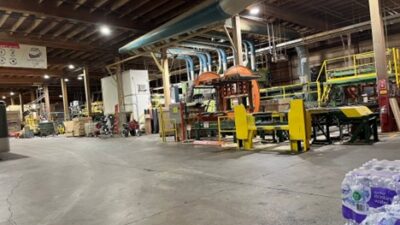
Owners often assume each OEM will handle the controls integration for its package, but that work usually falls through the cracks unless it’s explicitly scoped and budgeted. On one major wood-product industry upgrade, Revere warned the client to budget integrator hours for OEM interface work; the request was declined because to the owner, it looked like duplicate effort. They assumed the OEMs would handle that scope directly. The result was a $1 million change order once it became clear that OEM packages carried incompatible I/O maps and safety protocols. What looked like “overlap” on paper turned out to be a gap in the field that should have been caught early in the design process. In addition to exhausting contingency budgets, repeated incidents like this led to long-term strain on clients’ relationships with OEMs.
Vague scope or no FEED study
Modernizations frequently launch on incomplete piping and instrumentation diagrams (P&IDs) and sketchy load lists. Skip a front-end engineering design (FEED) phase and hidden cables, spare programmable logic controller (PLC) slots or virtual-server needs surface during commissioning — what should have been a one-hour tweak up front can become a many-hour scramble in the field.
This all-too-common just-enough design work also short-changes the people who keep the plant running once everyone leaves. Without annotated P&IDs, historian tag lists and version-controlled PLC logic, every future bypass or audit takes longer.
This problem is only growing. As modern systems rely more heavily on networked data, issues once solved with a cable pull now require nuances that no off‑the‑shelf spec could cover without a controls engineer at the table. Smart motor control center buckets, networked input/output (I/O) and data-driven analytics now require secure architectures: virtual machines to host historians, redundant safety virtual local area networks (VLANs) to segregate safety integrity level (SIL) traffic, firewall certificates and hardened cyber policies. Even a simple motor starter can stream live energy data. None of this appears on typical scope sheets unless a controls engineer writes them in. Complexity has multiplied and so has the cost of discovering it too late.
Early alignment through an owner’s automation engineer
The biggest project risks — scope gaps, rework, vendor misalignment — take root early. But that’s also where owners have the most influence to prevent them. It’s for this reason that we recommend owners embed an owner’s automation engineer early: a controls-focused advisor who joins at the same time as the civil and process teams to work with the owner in defining automation requirements.
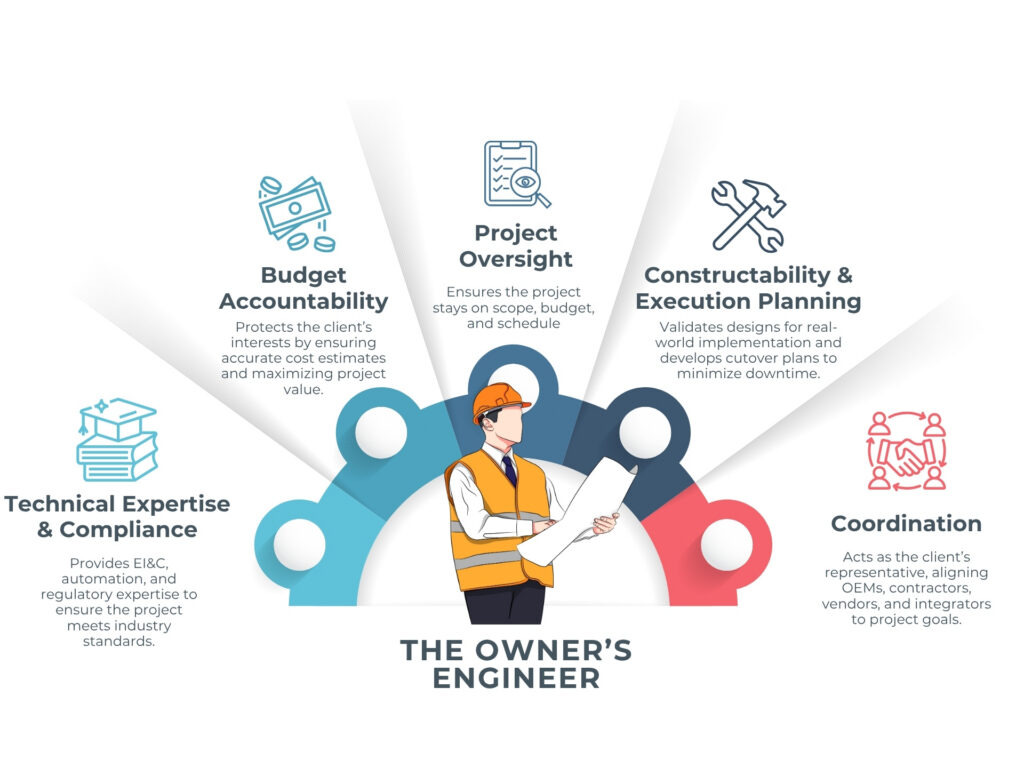
In practice, this owner’s engineer is rarely a single person but rather a team of integration and controls specialists lending their collective knowledge across areas like network design, safety systems, instrumentation and cyber standards.
Their role spans the full lifecycle, providing structure, oversight and technical accountability. This one point of contact protects project goals across five key fronts (see Figure 1).
- Budget accountability. With clear scope and engineering fidelity from the start, owners can generate accurate estimates and make informed procurement decisions. This avoids lowball budget assumptions that balloon into change orders later.
- Project oversight. The owner’s automation engineer ensures the project stays on schedule and aligned with automation goals, bridging the gap between process and controls throughout.
- Constructability and execution planning. At this stage, Revere validates that the designs will work in the field. That means confirming panel layouts, network architectures and I/O assignments match reality –– not just the drawings.
- Coordination. This role acts as the client’s translator and watchdog, aligning vendors, OEMs, integrators and contractors to eliminate scope overlap and ensure nothing falls between the cracks.
- Technical expertise and compliance. From safety instrumented systems (SIS) to cybersecurity standards, Revere ensures compliance is baked into the design rather than patched in after hardware arrives.
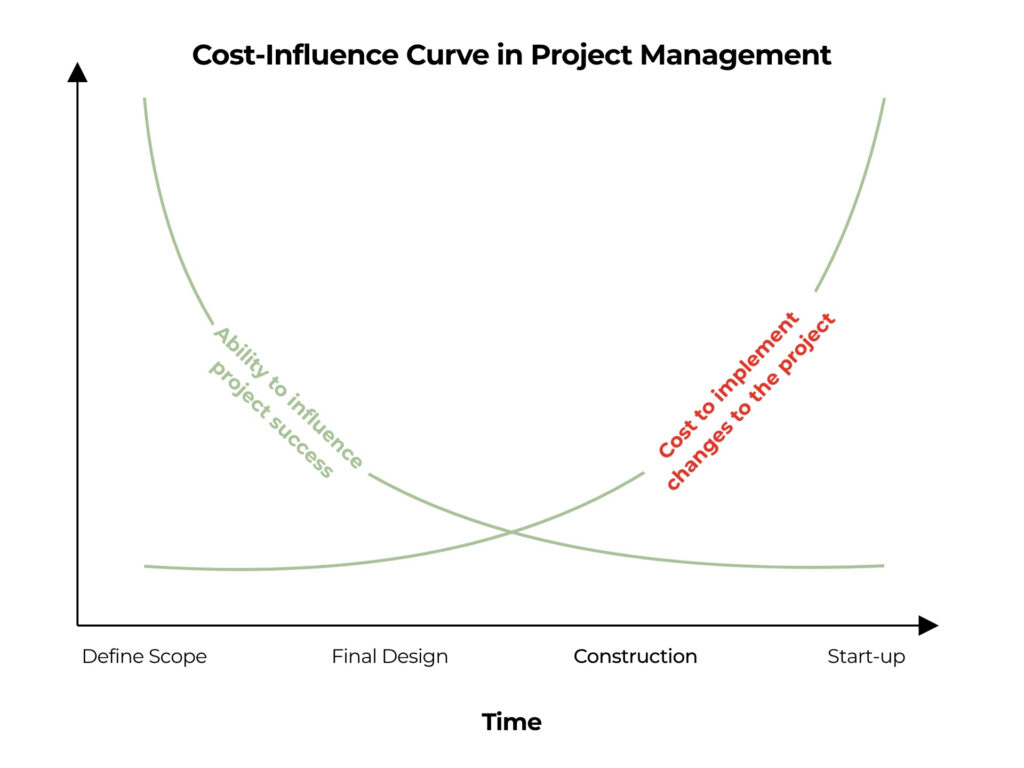
Why embed this role early? Because that’s where the return on investment (ROI) is. As shown in the cost-influence curve (see Figure 2), decisions made during early planning have the greatest impact on outcomes — and the lowest cost to change. Once equipment is ordered, the cost to correct design assumptions multiplies. The cheapest risk to eliminate is the one you catch before detailed design.

One way to formalize this early alignment is through a structured front-end process, often referred to as FEED (front-end engineering design) study or front-end loading (FEL) (see Figure 3). Revere’s FEED+ process delivers this as a series of time and materials (T&M) task orders, allowing flexibility while scope is defined, before locking into fixed-price packages downstream. The deliverables include:
- Clarified scope to ±10% fidelity, including a living I/O list, single-line diagrams and high-level network architecture.
- Standardized instrumentation and safety specs so OEMs quote apples-to-apples.
- An EI&C basis-of-design that feeds directly into issued-for-construction (IFC) documents.
Most architectural and engineering firms field just a few controls specialists, but an integrator’s bench can be 100% control-centric, so the detail defined in FEL survives all the way through startup when they’re involved early.
The value of this front-end approach has been clear in our work. During a recent biomass‑plant expansion project, a client opted to self‑manage a spark‑arresting system. When hardware arrived, coverage zones were wrong, some areas were over‑instrumented and panel drawings carried about 40% excess I/O. Revere was called to reconcile drawings, re‑scope devices and re‑program code — extra field time that ballooned far beyond what a simple coordination allowance would have cost.
FEED+, coordinated by an owner’s engineer, exists to prevent this kind of scenario. It validates layouts, matches I/O to real need and shifts critical EI&C decisions to the left side of the classic influence versus cost curve where each engineering hour saves many more in the field.
What unified EI&C ownership looks like
Once the FEED+ study is complete and the scope is locked, the same team that wrote it should build it. A vertically integrated EI&C partner delivers four tangible benefits (see Table 1).
| Benefit | What it Looks Like in the Field |
| Consistency in documentation | Controller tags, panel nameplates, historian points –– and critically, all engineering documents like schematics, loop sheets, interconnection diagrams, I/O lists and architecture drawings—match and align across the project. No translation spreadsheets or mismatched I/O maps to reconcile at startup. |
| Streamlined OEM coordination | Integrator joins factory acceptance tests (FATs), driving consistent network addresses and safety zoning. |
| Standardized hardware | MCC buckets, soft starters, SIS components, PLCs, I/O cards, HMI software licenses and server hardware are standardized across systems — reducing storeroom SKUs and simplifying lifecycle support. |
| Faster start‑up | Revere teams routinely cut commissioning hours by ~10% versus multi‑contract models. |
Table 1: Benefits of working with a vertically integrated EI&C partner. Courtesy: Revere Control Systems/Rivergate Marketing
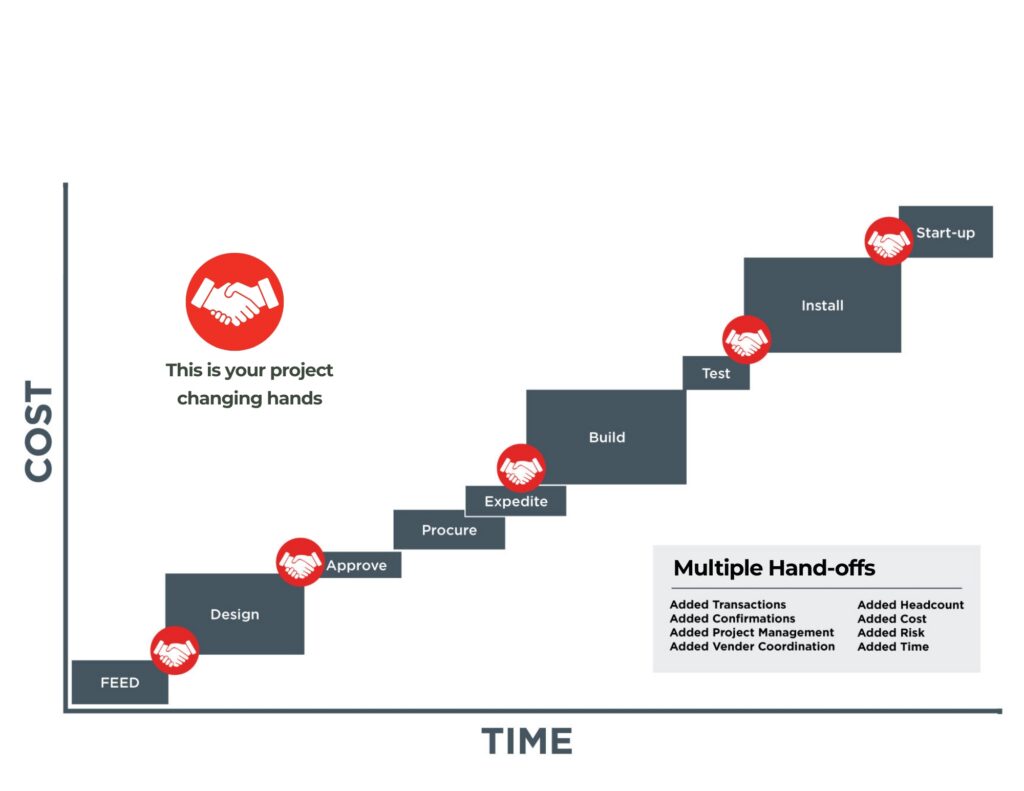
When the same team that scopes a job delivers it, the continuity reduces handoff gaps, clarifies accountability and ensures that early design decisions carry through to startup. When the integrator owns both the plan and the outcome, there’s no finger-pointing and the time to startup is much shorter with fewer changing of hands (see Figure 4).
Contract structures that encourage alignment
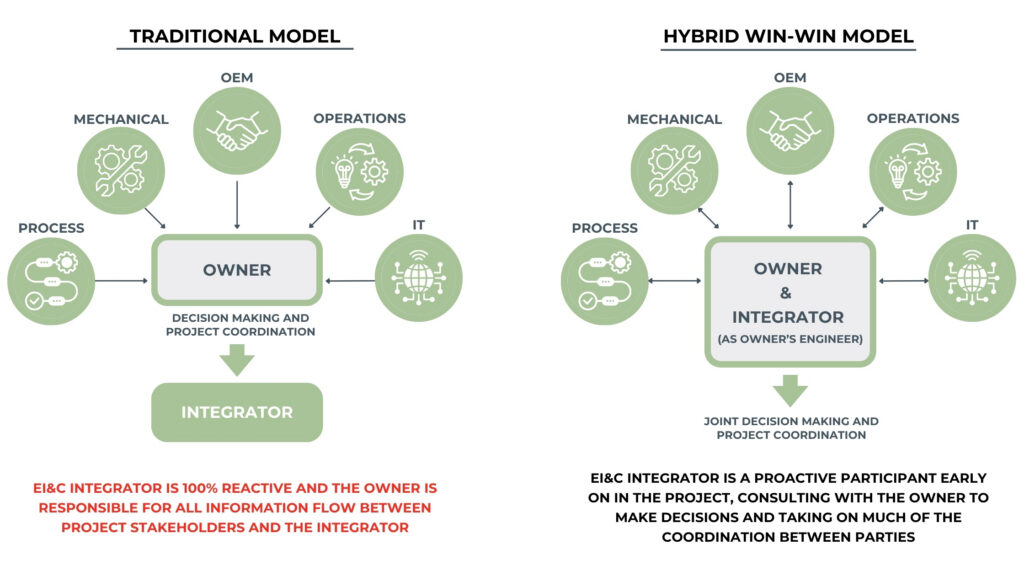
Revere uses a win‑win hybrid model (see Figure 5) that aligns incentives without locking every phase into inflexible fixed-price boxes.
- Phase 0–1 (Objectives and clarify scope): Time and materials (T&M) under a master‑service agreement –– maximum flexibility while risk is highest.
- Phase 2 (Detailed EI&C design and panel supply): Fixed price with a jointly‑agreed contingency; owner and integrator share underruns.
- Phase 3 (Installation): Cost‑plus fee or guaranteed max price when labor exposure dominates.
- Phase 4 (Checkout and commissioning): T&M again, because discovery work continues until startup key performance indicators (KPIs) are met.
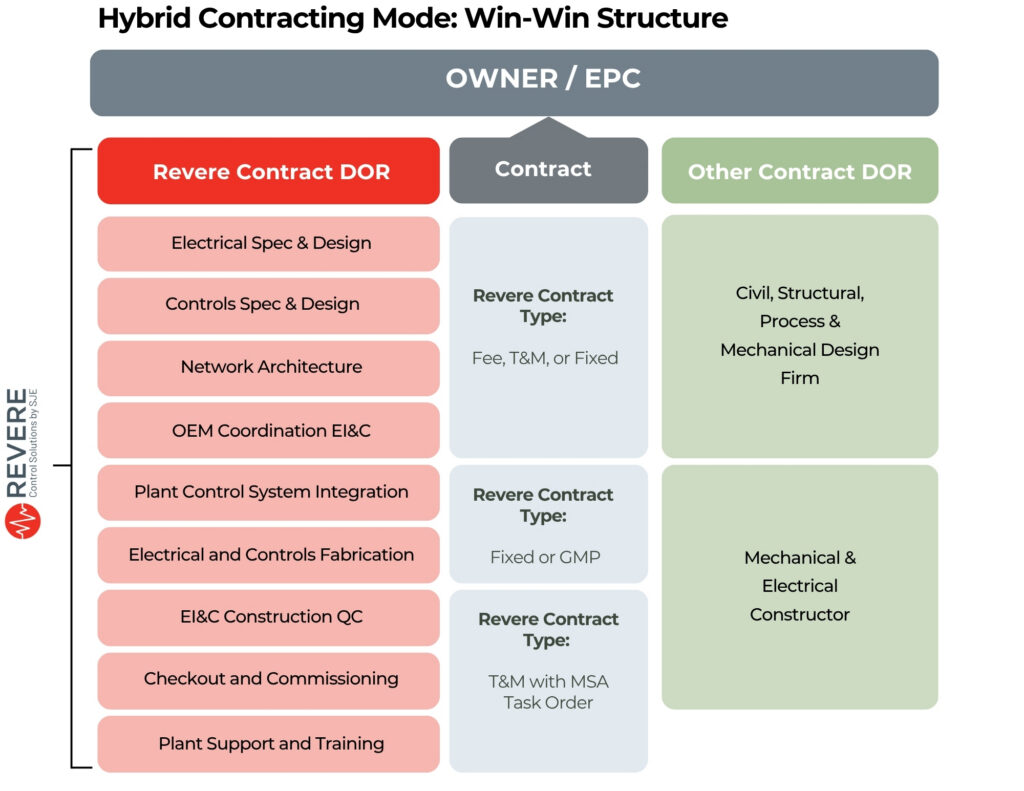
In Figure 6 are the recommended contract structures for each phase of a project. This win-win structure encourages alignment between the owner and integrator while sharing risk. This mix turns cost unknowns into shared opportunity, not finger‑pointing. The result is cost transparency early, price certainty when details are firm and a shared goal of startup success.
Don’t let EI&C slip through the cracks
A project’s automation layer may be only 10% to 15% of capital expenditure, but it sits squarely on the critical path. When that slice is split among multiple firms, change orders and start‑up delays creep in unnoticed. One accountable partner can change that.
What a unified EI&C partner delivers
- Closes the three gaps that derail projects: fractured scope, unfunded OEM coordination and fuzzy design assumptions.
- Compresses schedules and reduces change orders: through an aligned hybrid contract that puts cost certainty where details are known and flexibility where discovery is still needed.
- Delivers a maintainable asset to operations: standard hardware, fully documented code and a cyber‑secure network that IT can live with.
EI&C is not a commodity; it is a major factor that makes or breaks commissioning. Owners who embed an integrator early, via FEED+, unified design and OEM oversight, replace responsibility avoidance with technical alignment and predictable start‑ups.
Some industries are already moving in this direction. In public infrastructure projects, especially in water, integrators are already often being embedded early as part of design-build teams. But in the industrial sector, they’re still treated as the final stop, brought in to wire up someone else’s plan. One client summed up the dilemma well: “We wanted to go the vertically integrated route, but we couldn’t find a second firm to bid it that way,” so they reverted to split scope and lived with the gaps. The appetite for this kind of execution model exists, but the structure just hasn’t caught up yet.
In this moment, where downtime is measured in lost revenue minutes, single‑source automation accountability isn’t a luxury –– it’s a competitive advantage.
Greg Graves leads strategic development for Revere Control Systems. Edited by Sheri Kasprzak, executive editor of Automation & Controls, WTWH Media, [email protected].