Most installed flowmeters do not measure the desired flow measurement parameter. Nonetheless, flowmeters should be evaluated based on the desired measurement, such as mass flow, using a common measure, such as a percentage of the actual flow rate.
Flowmeter measurement insights
- Different flowmeters measure different parameters to determine flow
- Flowmeter accuracy specifications are often expressed differently
- Evaluation of flowmeter accuracy should be based on both a common measure, such as a percentage of the actual flow rate, and a common parameter, such as mass flow
Flowmeters that measure different parameters can produce different results, so flowmeter accuracy should be evaluated based on the measurement of a common parameter. Flowmeters in industry typically measure parameters associated with the fluid passing through the flowmeter. Positive displacement flowmeters measure the flowing volume directly. Fluid velocity can be measured using magnetic, turbine, ultrasonic and vortex shedding flowmeters. Differential pressure, target, and variable area flowmeters do not measure the flowing volume, fluid velocity or mass, but rather measure inferentially, as explained in “Industrial Flow Measurement, third edition” David W Spitzer, ISA Press, 2005, pages 113-115. Coriolis and thermal flowmeters measure the mass of the flowing fluid. In addition, the Energy Correlation Method can enable differential pressure flowmeters to measure mass flow. [See below, “Mass flow measurement with differential pressure flow elements.”]
Desired flow measurement
The overwhelming majority of processes are inherently dependent on the number of molecules that move from one location in the process to another, and not the fluid volume (size), fluid velocity (speed) or some other parameter. If measuring mass flow is desired, why is it commonly acceptable to install flowmeters that measure other parameters? For currently available technologies and common industry practice, flowmeters that measure parameters other than mass are practical, familiar and less expensive than the available mass flowmeter option(s). Regardless of general practice, flowmeters should be evaluated based on the desired measurement, which is usually mass flow.
It is important to recognize that for some applications, mass flow is not the desired parameter. By way of example, mass flow would be a reasonable surrogate to measure the flow of energy in natural gas with known composition. In an actual installation, unmeasured fuel-rich waste gas flow variations caused an incinerator to exhibit temperature fluctuations detrimental to its operation and maintenance. The desired measurement parameter was not mass flow, but rather the flow of energy in the waste gas, which contained unknown quantities of ammonia, hydrocarbons, hydrogen, nitrogen and other chemicals. Measuring the heat content of the waste gas online is complicated and expensive, so a flowmeter was installed that may have measured the flow of energy within 10-20% (or worse). Yet, using this measurement to compensate for most of the variations enabled temperature control within 1 deg C of its 982 deg C setpoint.
History: Easier to understand flowing volume
Early flowmeter design engineers focused development efforts on flowmeters that determine the flowing volume. This is understandable because the concept of volume was easier to visualize than the mass of an object, especially since flowmeter technologies that measure mass flow were not yet viable. The availability of practical Coriolis and thermal flowmeters in the 1980s, and the Energy Correlation Method developed in the early 2020s increased attention on mass flow but did not dramatically alter the general practice of installing flowmeters that determine the flowing volume.
Whereas positive displacement flowmeters measure the flowing volume directly, velocity measurements are multiplied by the cross-sectional area of the flowmeter to calculate the flowing volume. Differential pressure measurements use calculations to infer the flowing volume. Mass flow can be calculated by multiplying the flowing volume from any of these flowmeters times the flowing density. However, the flowing density can change with varying fluid composition and operating conditions, especially in gas flow applications. When mass flow errors associated with these variations are significant, a flow computer or other device can be installed to compensate for the raw measurement using various techniques, such as pressure and temperature compensation for gases, temperature compensation for liquids, and online density measurement compensation. However, additional measurement instruments and calculations add complexity and cost to these installations.
Mass flow accuracy
The mass flow measurement errors associated with each flowmeter technology are different. Positive displacement flowmeters and flowmeters that measure the flowing velocity are directly affected by density variations, such as can be caused by varying composition, temperature and pressure. For example, if fluid density increases by 1%, the mass flow increases by 1%. Differential pressure flowmeters react differently, where the same density change will decrease the measured flowing volume by approximately 0.5%.
Flowmeter accuracy expressed as a percentage is incomplete because it does not state a reference value. There are significant differences between flowmeters with accuracy expressed as 1% of the actual flow rate, 1% of span, 1% of full scale, 1% of calibrated span, and 1% of meter capacity. Therefore, the accuracy of different flowmeters should be compared using a common measure, which for flow measurement has long been a percentage of the actual flow rate.
In practice, two flowmeters with the same percentage of rate accuracy statement are considered to provide equivalent measurements. However, if one flowmeter measures the flowing mass and the other measures the flowing volume, their performance can be decidedly different. For example, a mass flowmeter will measure mass directly, but the mass flow through a flowmeter measuring a constant velocity will change with changing fluid density. Therefore, flowmeter accuracy should be evaluated using a common measure and on the measurement of a common parameter, which is most often mass flow, the desired parameter in most applications.
Variables that affect mass flow measurements
As previously stated, mass flow measurements can be obtained by multiplying the flowing volume times the operating density. These measurements are affected by variables that influence the installed flowmeters. For example, Reynolds number, which is a function of density and viscosity at flowing conditions, can affect differential pressure, turbine, ultrasonic and vortex shedding flowmeters. Magnetic flowmeters can be affected by the conductivity of the fluid. The following discussion focuses on flowmeters that measure mass flow, albeit with caveats.
Physical property variations have negligible effects on flowmeters that measure mass flow directly, such as Coriolis mass flowmeters. Note that the accuracy when measuring gas can be degraded significantly because operation is usually low in the measurement range due to hydraulic considerations.
The applicability of thermal flowmeters is generally limited to measuring the mass flow rate of gases with known composition and known thermal properties that operate within temperature, pressure and composition constraints. Changing composition and operation outside of the constraints can introduce significant mass flow measurement errors. By way of example, thermal flowmeters measuring natural gas were shown to be in error by as much as 10% due to different natural gas compositions in different locations, according to Greg Smith, Ria Edens and Riccardo Hassan, “Case Study on Thermal Flow Meter Calibration for Natural Gas Service,” Fox Thermal Instruments, Case Study.
Differential pressure flowmeters can be widely applied when mass flow is measured using the Energy Correlation Method, which is independent of Reynolds number. However, without compensation, increasing the flowing density by 1% causes measurements to decrease by approximately 0.5%. While potentially significant, this is approximately one-half of the effect exhibited by flowmeters that measure volume and velocity to determine the flowing volume.
Mass flow measurement with differential pressure flow elements
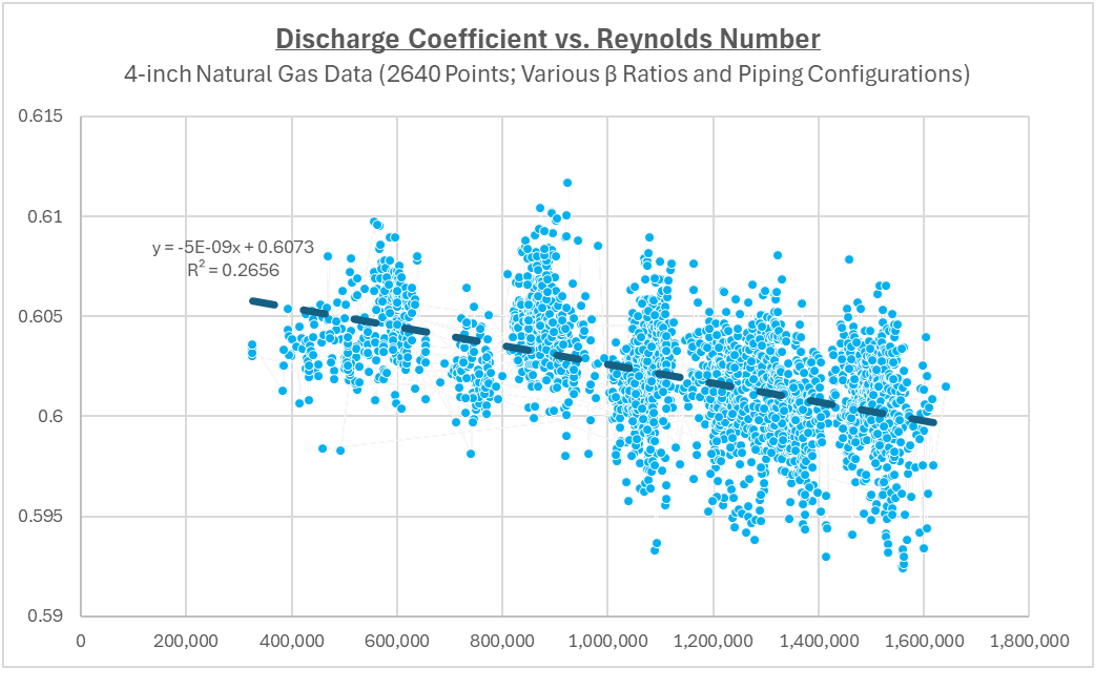
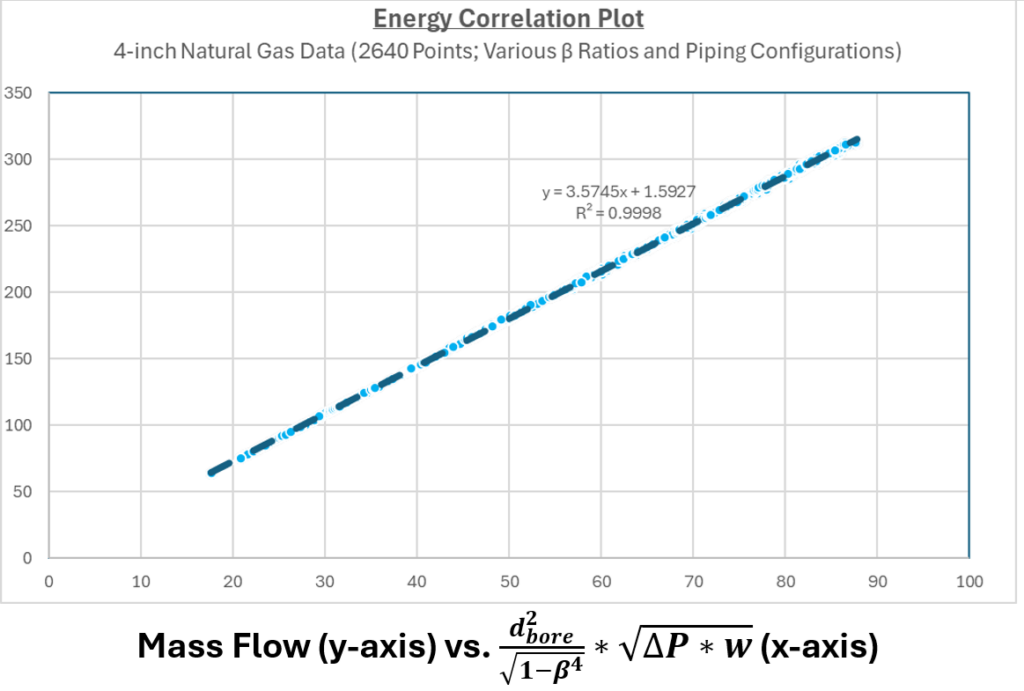
The Energy Correlation Method (ECM) used to determine the mass flow through differential pressure flow elements was developed by Dr. Zaki Din Husain in the early 2020s, as noted by Bell Technologies, Zaki Din Husain, United States Patent 12,241,771 B2 March 4, 2025. Traditional methods use Reynolds number, which is a function of the flow rate, operating viscosity, and operating density, to calculate a discharge coefficient that is used to determine the flowing volume based upon the measured differential pressure (Figure 1). Using the ECM, the mass flow through differential pressure flow elements is a linear function of the square root of the measured differential pressure. and operating density. Aside from being less complicated, the following traditional and ECM plots of the same data show that the ECM is superior to traditional methods, as illustrated by their R-squared values (goodness of fit, Figure 2). [Figure 1 and Figure 2 are from David W Spitzer, “Energy correlation method: Measuring mass flow with differential pressure flowmeters.”]
Flowmeter selection
Assume that Flowmeter A and Flowmeter B have accuracies of 0.5% and 1% of the actual flow, respectively. Which flowmeter exhibits superior accuracy? One would logically select Flowmeter A, but based upon previous discussion, there is insufficient information to make this determination. Are these flowmeters measuring gas with varying operating pressures? Is Flowmeter A measuring the flowing volume while Flowmeter B measures mass flow? If so, Flowmeter B could be superior, which appears counterintuitive until they are compared based on their mass flow accuracy. This is aside from the observation that the seemingly superior Flowmeter A is not making the desired measurement.
This exercise is not intended to imply that all flowmeters should be mass flowmeters, but rather that the accuracy of different flowmeters should be evaluated on a common basis, which is usually mass flow accuracy, and not on the accuracy with which a flowmeter measures some other parameter. This approach can expose influences that would otherwise not be apparent when comparing flowmeter accuracy statements based on different parameters.
Thermal flowmeters have niche applications that often dictate their use. Extensive use of Coriolis mass flowmeters can be expensive. In contrast, differential pressure mass flowmeters using the Energy Correlation Method are widely applicable and cost-competitive with flowmeters that measure volume, velocity and inferentially.
Summary: Evaluate flowmeters based on desired measurement parameter
It has long been established that flowmeter accuracy should be evaluated based on specifications expressed as a percentage of the actual flow rate at different flow rates. This discussion suggests that such evaluations alone may not expose potentially significant adverse effects caused by the flowmeter technology itself in conjunction with actual operating conditions. Therefore, evaluation should be based on the desired measurement parameter, such as mass flow, using a common measure, such as a percentage of the actual flow rate.
David W Spitzer, process control author; Edited by Mark T. Hoske, editor-in-chief, Control Engineering, WTWH Media, [email protected].
Keywords
Flowmeter selection, flowmeter accuracy
Consider this
Are you selecting flowmeters based on application-appropriate measurements?
You also might like
See more on process instrumentation and sensing.