GenAI tools embedded in advanced analytics platforms promote workforce learning and upskilling, essential components for adopting new technologies that improve operational efficiency in manufacturing environments. Overcome four AI adoption challenges.
Industrial AI adoption insights
- Four industrial artificial intelligence (AI) adoption challenges are human opposition, learning curve, cost and job security concerns.
- Tips show how to building trust for industrial AI and data analytics along with how to integrate generative AI.
- Examples show how accelerating learning at a technology company and sugar refinery resulted in improvements and growth.
In today’s fast-paced industrial environments, manufacturers are tasked with transforming massive amounts of information into actionable insights in short stints of time, and industrial artificial intelligence (AI) software can help. Real-time operations require processing data as it is generated to effectively fine-tune control systems and optimize production.
While new technologies are emerging to perform these and other tasks, finding the right fit for every application is often challenging, and keeping up with frequent advancements can be taxing for organizations.
Today’s most forward-thinking industrial organizations are investing in innovative technologies, such as AI tools and advanced analytics, to stay competitive and drive continuous improvement. Beyond operational efficiency, these technologies also help foster workforce development when accompanied by personalized on-demand training and industry-specific onboarding experiences.
Four AI adoption challenges: Opposition, learning curve, cost, job security
Adopting new technologies for data management and insight generation naturally comes with headwinds.
1. Staff may resist AI: First, implementation champions in many companies must overcome innate staff resistance to workflow disruption by addressing readiness, acceptance, and skillset hurdles, especially in settings with long histories of relying on traditional data management methods. Oftentimes, these impacted senior subject matter experts (SMEs) are accustomed to manual data cleansing and analytical calculations, and as a result, they trust tried-and-true methods above automated tools.
2. Learning curve for AI use: Even when employees are open to new methods, the initial learning curve and time required to become proficient is a significant initial speed bump to overcome. Many companies operating lean in fast-paced industries struggle with sufficient resources to weather these time requirements, whose employees are too busy to dedicate substantial time to learning. Most industry analytics and AI data tools require programming expertise—such as Python—or familiarity with machine learning model tuning concepts, and the process engineers who these tools benefit are not commonly trained in either area. The lack of familiarity with required concepts makes the learning period more daunting.
3. Cost of AI: Cost is a concern when implementing new technologies or platforms. Many modern AI and analytics platforms require upgrades to existing computational infrastructure and data storage capabilities, which demand significant investment, in addition to the new system itself. For organizations not already equipped with sufficient computing resources either on-prem or in the cloud, capital costs can be considerable, and ongoing maintenance, upkeep, and subscription fees can add further strain, especially in budget-limited organizations.
4. Concerns about AI, job security: Finally, some workers understandably express job security concern, worrying about role replacement by automation and AI technology. This uncertainty can sow significant hesitation to adopting new technologies, as personnel do not eagerly embrace tools that change the way they work without quickly experiencing tangible benefits. This latter point is the key to successful implementation, but effectively communicating benefits requires thoughtful upskilling initiatives.
Building trust for AI, data analytics
Considering these challenges, organizations need well-planned strategies and sufficient resources to smoothly implement advanced data analysis and AI technologies. Pilot programs often provide an effective approach, enabling small teams to test innovations prior to full enterprise-wide rollout. This tactic equips carefully selected user groups with hands-on experience, without subjecting personnel to a forced and immediate switch.
As key users gain experience, they are then able to pass on their notes and knowledge of the new technology to others in the organization. These shared success stories can create positive sentiment among teams, especially when employees hear about benefits from trusted peers and can quickly experience tangible results for themselves.
Integrating GenAI
Generative AI (GenAI) can help accelerate the learning curve by minimizing the need for formal education and extensive training, instead providing users with exposure to tools and tricks via automatically prompted recommendations based on current context. GenAI uses deep learning to create new content such as text, images, or code by learning patterns from existing large datasets. The foundation models are trained on comprehensive datasets, enabling them to understand and generate new contents in response to user prompts.
This enables construction of complex queries using simple plain-language prompts, a capability that is particularly beneficial for engineers without extensive programming expertise. For instance, GenAI can assist in both debugging code and helping users understand its functionality.
Accelerating learning at a technology company and sugar refinery
For one leading global technology provider, implementing a GenAI-equipped advanced analytics platform played a crucial role in its digital transformation journey. The company leveraged an advanced analytics and AI platform, to support its teams in transitioning from a legacy to a modern analytics platform. This approach drastically helped overcome initial employee resistance to change.
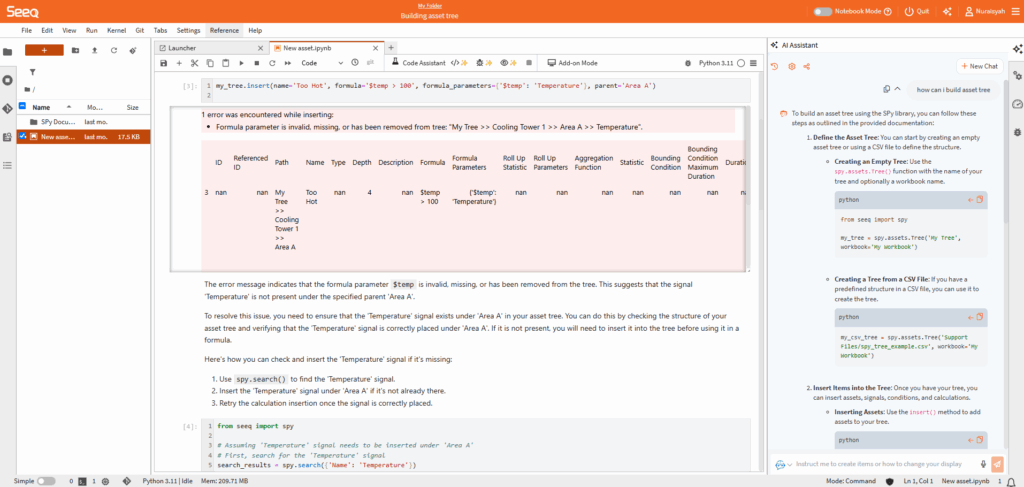
By offering targeted support and guidance, the software’s AI assistant, embedded within the advanced analytics platform, empowered the company’s teams to quickly learn how to navigate data analytic tools, streamlining the transition process and reducing the time required for users to create value with the new technology (Figure 1).
GenAI, while powerful, requires human validation to ensure accuracy, especially in complex or critical manufacturing processes, and these limitations prevent it from replacing skilled personnel. For instance, in a manufacturing plant, engineering presence is still crucial for executing actions based on AI insights, in addition to providing technical knowledge and contextual understanding that AI systems lack. These key personnel are needed to interpret data, make informed decisions, and address unforeseen challenges that arise during production.
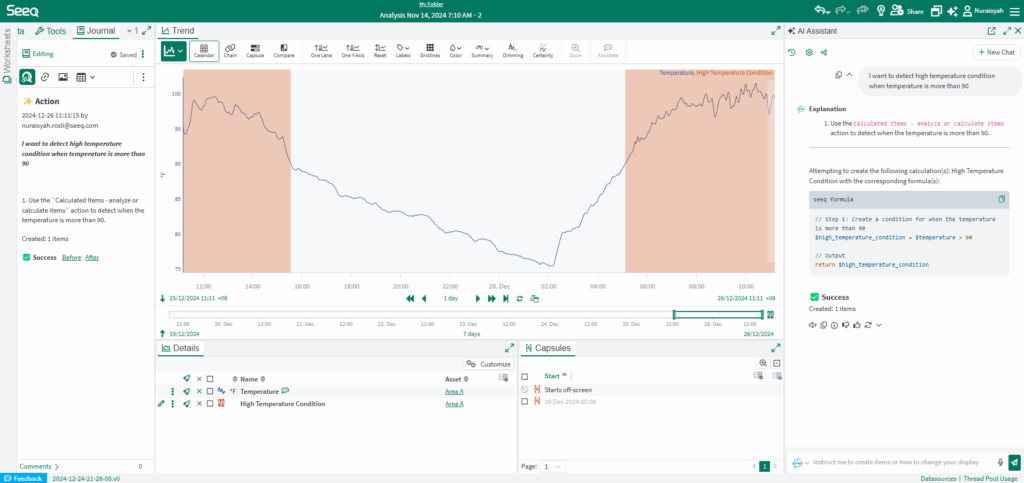
The collaboration between AI and skilled workers can lead to improved efficiency and innovation, enabling humans to focus on higher-level strategic tasks while AI handles routine analyses and data processing (Figure 2). This approach enhances operational effectiveness and reassures employees that their roles remain integral to the manufacturing process.
A leading sugar refiner in the UK adopting the same analytics platform found that the AI Assistant enabled its subject matter experts to reduce analysis time by 50%. This efficiency gain empowered the team to dedicate the newfound time to implementing solutions directly, and, as a result, they now complete tasks up to eight times faster without needing to rely as heavily on external resources.
AI, analytics propel improvements, growth
While implementation costs and learning curves pose understandable barriers for many organizations, the return on investment from AI-equipped advanced analytics platforms usually more than justifies the initial expense. These types of tools integrate data from multiple sources, simplifying performance analysis and enabling organizations to identify and promptly address inefficiencies within existing processes. This capability empowers teams to target specific operational issues, reducing maintenance costs, improving equipment reliability, and increasing productivity over time.
The combination of advanced analytics platforms and GenAI is changing the way manufacturers work, making it easier to improve and grow. Together, these tools help turn large datasets into clear and actionable insights, in addition to accelerating the learning period for employees.
Generative AI promotes honing new skills, while analytics platforms facilitate effective use of data for improved decision-making. This powerful mix enables companies to overcome challenges, improve efficiency, and encourage new ideas, helping them stay competitive and adapt to the demands of a data-driven world.
Nuraisyah Rosli is an analytics engineer at Seeq. Edited by Mark T. Hoske, editor-in-chief, Control Engineering, WTWH Media, [email protected].
Keywords
Industrial GenAI, debugging code, data analytics
Consider this
Are you using GenAI industrial software?
You also might like
Control Engineering provides more GenAI insights from Seeq.
How Generative AI is Transforming Industry: Insights from Seeq’s Mark Derbecker
How to bridge the digital maturity gap in the Industry 4.0 era