The standard covers magnet wire dimensions, tolerances and test procedures for coils used in electrical equipment.
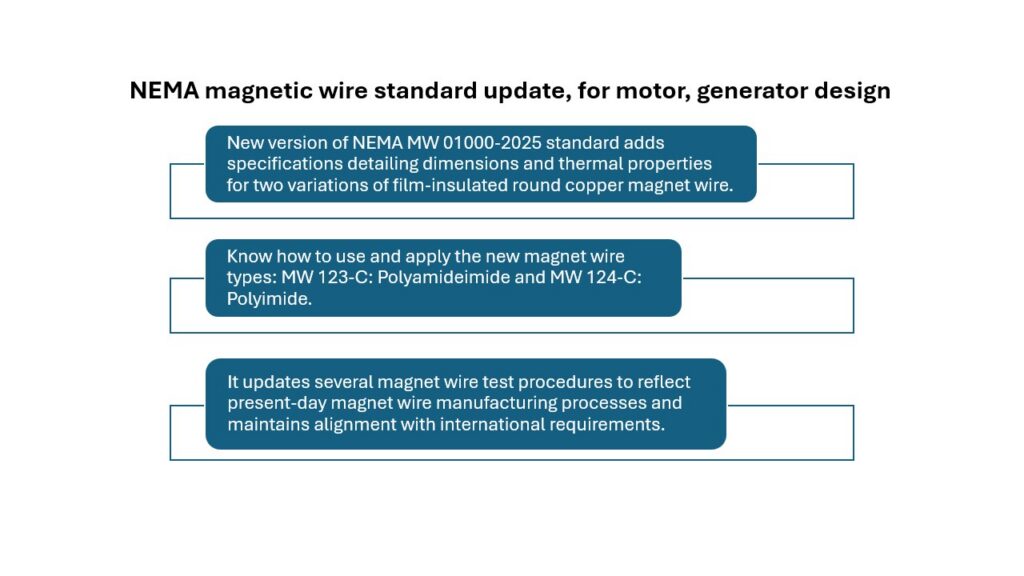
The Magnet Wire Standard from NEMA provides users of MW 1000 with a concise reference to common performance requirements for film-insulated magnet wire constructions according to conductor material and insulation build. In the case of any discrepancies between this supplement and MW 1000, the requirements in MW 1000 prevail. The new version (NEMA MW 01000-2025) adds specifications detailing the dimensions and thermal properties for two variations of film-insulated round copper magnet wire: MW 123-C: Polyamideimide and MW 124-C: Polyimide. The new specifications allow stakeholders to utilize and apply the new magnet wire types. The standard also updates several magnet wire test procedures to reflect present-day magnet wire manufacturing processes, and to maintain alignment with international requirements.
Magnet wire is the primary component for creating electromagnetic fields by converting electrical energy into magnetic energy, making it essential for devices like motors, transformers, inductors and generators, which are fundamental to modern technology and power systems. Any motor or transformer used in existing and newly electrified application requires magnet wire to function as intended. MW 01000 establishes the necessary mechanical, chemical, electrical, and thermal requirements for magnet wire. Some of the many applications that utilize magnet wire are the operation of industrial machinery, fans, blowers, pumps, turbines, and heating and cooling systems. It is estimated that 90% of all electrical energy requires the use of magnet wire to be used. Quality magnet wire ensures low energy loss, durability, and the ability to operate at high temperatures, which is crucial for motors used in demand environments.
Patrick Hughes, NEMA senior vice president of strategy, technical, and industry affairs, answered Control Engineering’s questions about the new standard.
What does this standard enable users to achieve?
This standard enables machine designers and system integrators to address certain technical and commercial risks when specifying magnet wire for motors, generators and transformers. So, consider a scenario where a motor product specifier needs to select an enameled magnet wire that meets specific dimensional, mechanical, chemical, electrical and thermal requirements for their specific application, MW 01000 supports this process by documenting the minimum requirements that all major wire enamel families exhibit, giving designers a clear reference for matching wire capabilities to the demands of a specific application.
What applications will the standard help?
This is particularly useful when designing equipment for transformers, industrial motors, electric vehicle (EV) powertrains, renewable energy systems, and other intense applications, where wire failure could lead to costly equipment failure and potential safety issues. So, designers can get ahead of this risk by referencing proven industry requirements using MW 01000 — eliminating the guesswork in wire selection.
The NEMA standard is available here: https://www.makeitelectric.store/us/view-details/supplement-to-ansinema-mw-1000-reference-requirements-for-round-film-insulated-magnet-wire
Edited by Mark T. Hoske, editor-in-chief, Control Engineering, Arrowfly Media, [email protected].