Partnering with leading instrumentation suppliers helps process professionals fill critical gaps, providing real-time diagnostic sensing insights, centralized documentation, and on-site measurement expertise, which transform downtime into dependable and cost-effective production.

New process sensors, expert services, benefits insights
- Hardware, software and skills gap issues create barriers to consistent production, process efficiency.
- Instrumentation and expert services help condition monitoring, process documentation and support.
- Examples include scalable digital transformation for a bottling company and instrumentation consultation and support at a smelting plant.
Manufacturers must balance relentless productivity demands with stringent quality and safety requirements, including with process instrumentation hardware, software, workflows, calibration and services to ensure sensors are providing needed information, as part of today’s competitive industrial landscape. It’s more complicated when plants have fragmented instrumentation data, reactive maintenance habits and staffing shortages, factors that collectively erode uptime and inflate costs.
Instrument suppliers with consultative and technology-driven approaches can help companies address these and other pain points, restoring reliable and cost-effective operation. Real-world case studies from a bottling operation and a metal smelting plant illustrate how scalable digital tools, hands-on support and holistic engineering services can dramatically improve plant reliability, reduce unplanned downtime, and unlock the full value of existing instrumentation.
Barriers to consistent production, process efficiency
Processors across a broad spectrum of industries frequently encounter a recurring set of challenges to operational efficiency. Digital records often end up siloed or incomplete, making it difficult to trace equipment calibration and maintenance history, verify compliance, and extract actionable insights. Manual and reactive asset management activities frequently result in missed calibration windows, inconsistent spare parts inventories, and suboptimal use of available equipment.
In many cases, these challenges are exacerbated by overextended technical staff. A limited pool of plant engineers and technicians that juggle troubleshooting and preventive upkeep tasks, leaving little capacity for strategic improvement.
Unplanned downtime—whether a result of equipment failure, calibration errors or inadequate monitoring—can cost millions annually, disrupt supply chains and jeopardize regulatory compliance. These intertwined issues create a vicious cycle where a lack of accessible data fuels inefficient resource allocation, which in turn can cause downtime and financial loss.
Instrumentation, services help condition monitoring, process documentation, support
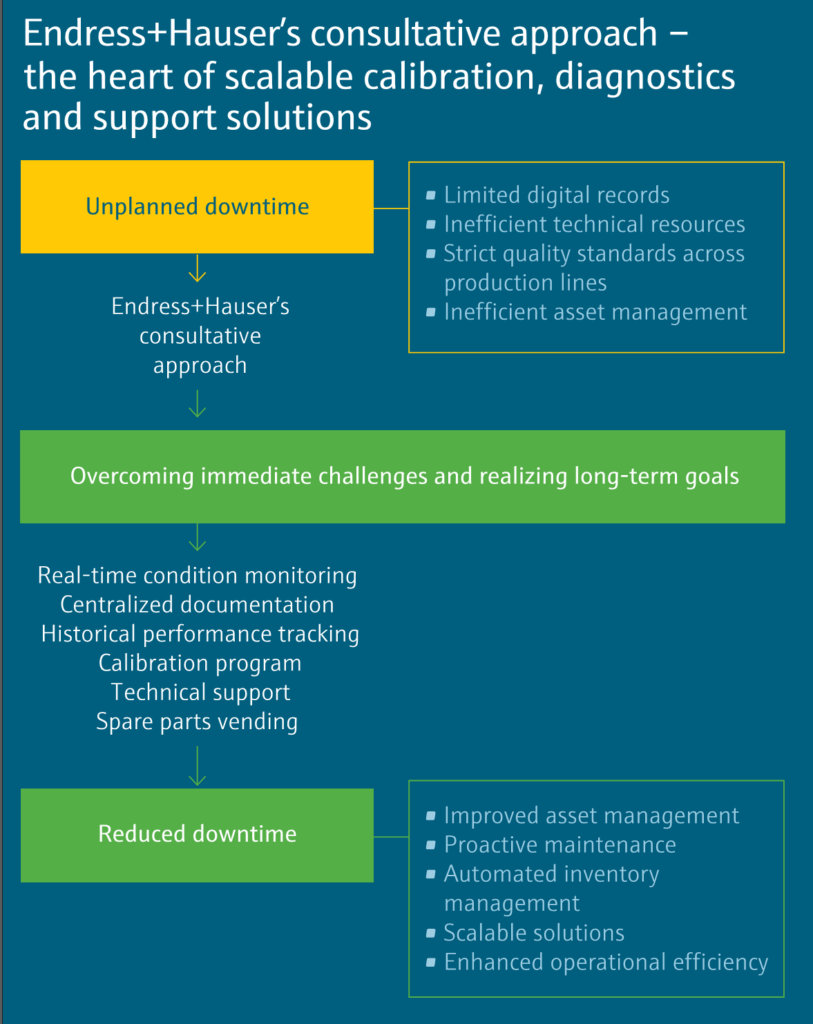
Top instrumentation suppliers partner with processors across multiple industry segments and maintain a deep understanding of issues affecting plant personnel. Suppliers can use a consultative approach that blends real-time condition monitoring, centralized documentation and expert on-demand support (Figure 1).
Consultative engagement begins with a discovery phase in which the supplier’s engineers work with plant leadership to map current workflows, data gaps and pain points. By asking targeted questions and reviewing existing instrumentation, they identify each facility’s unique needs, such as tighter calibration control, faster spare parts replacement or deeper insight into process variability. The findings are applied toward solutions aligned with the processor’s specific objectives and budget.
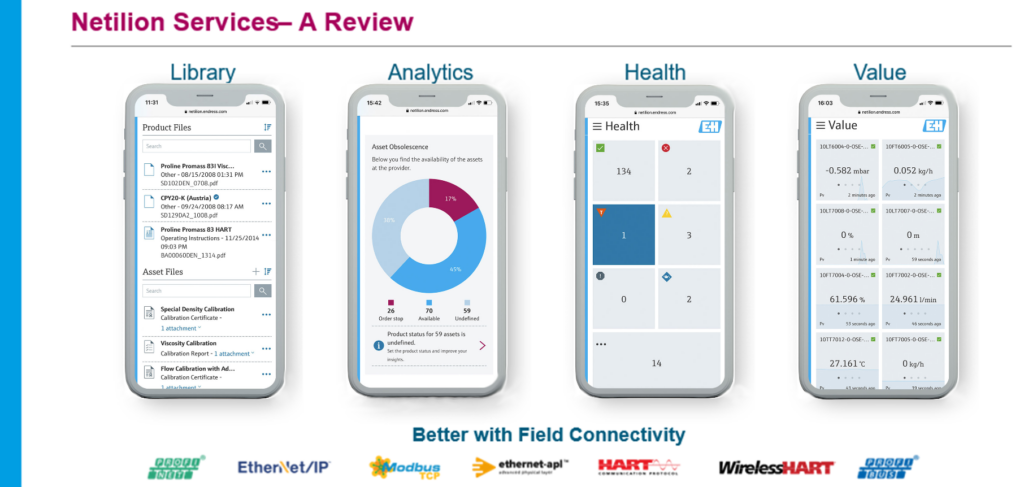
Central analytics and insight platforms are frequently employed, which provide plants with continuous health diagnostics for every instrument so that subject matter experts (SMEs) can adopt predictive, condition-based maintenance practices, rather than costly time-based service schedules (Figure 2). All calibration results, device logs and performance trends can be stored in these unified libraries, providing instant, audit-ready documentation and a single source of truth for asset managers, along with historical performance analytics that empower teams to spot degradation patterns early.
For facilities experiencing a shortage of technical staff, leading suppliers can supplement in-house plant personnel with hands-on support and coaching, amplifying immediate and long-term workforce effectiveness. In addition, 24/7 remote support via digital tools empowers companies to diagnose and resolve urgent issues.
Such capabilities reduce unplanned downtime, streamline asset management and boost operational and maintenance efficiency. Modular and scalable solution can be rolled out incrementally as needs require, while maintaining confidence through close collaboration with a trusted partner.
Scalable digital transformation for a bottling company
A leading U.S. bottler was facing several interrelated challenges with its operational reliability. Fragmented digital records and reactive maintenance practices inhibited the company from responding quickly to compliance audits and equipment failures, resulting in frequent unplanned downtime.
The company struggled to uphold consistent process traceability across multiple production lines, risking regulatory penalties and lost business. Lack of real-time visibility into the condition of critical devices forced the maintenance team into routine, time-based services instead of predictive and condition-based interventions.

Three ways to improve instrumentation applications
An instrumentation supplier conducted workshops and interviews with senior leadership and plant managers to extract operational priorities (Figure 3). This effort produced three core solutions:
- Unified calibration strategy: A cross-site calibration framework introduced standardized key performance indicators (KPIs) and digital reporting. Calibration downtime was contractually aligned with preventive maintenance windows, ensuring minimal disruption while preserving data integrity.
- Condition-based maintenance via Netilion: Leveraging smart instrumentation, the Netilion platform delivers continuous device health monitoring, centralized documentation, and historical performance analytics.
- Dynamic spare parts management: Endress+Hauser piloted a flexible spare parts program at five sites, validating and refining inventory levels and logistics before scaling the approach enterprise-wide.
Benefits included:
1. Turning fragmented and reactive processes into a cohesive and data-driven maintenance ecosystem that delivered measurable gains immediately.
2. The real-time diagnostics in the bottler’s Netilion dashboards now flag instrument anomalies long before they impact the production line, which reduced unexpected shutdowns.
3. Automated calibration records are seamlessly linked to business systems, delivering audit-ready documentation that satisfies Food and Drug Administration (FDA) and other regulatory requirements.
4. Standardized calibration data stored in Netilion improves records visibility, empowering maintenance crews to act swiftly and confidently when issues are detected.
Scalable digital tools, continuous diagnostics and round-the-clock technical information helped the bottling company enhance operational efficiency and regulatory preparedness, positioning the company to acquire and retain strategic agreements.
Smelting plant: Instrumentation consultation, support
A smelting company was experiencing downtime, delayed projects and uneven maintenance, all stemming from a thin technical workforce and aging infrastructure. With 20% of the fulltime staff needed to run the plant effectively, the company faced a large backlog of commissioning, troubleshooting and preventive maintenance tasks.
The processor commissioned an instrument supplier to produce objectives focused on realistic outcomes, rather than sweeping theoretical digital transformation. The resulting joint team developed a phased roadmap that tackled operational gaps while laying out a clear trajectory for long-term reliability and efficiency. The plan emphasized on-site support, instrumentation that closed critical gaps and continuous knowledge transfer.
Flowmeters, level sensors, pressure transmitters, analytics
Instrumentation installations included:
- Flowmeters in key process streams to deliver accurate material balance data and reduce waste.
- Level sensors in tanks and vessels to ensure feedstock availability and prevent overfills.
- Pressure transmitters and gauges in high-pressure systems to enhance safety and control.
- Liquid and optical analysis instruments to provide real-time chemical and gas data, supporting compliance and safety.

All devices were fully commissioned and integrated into the plant control logic, and subject-mater experts worked with the smelter staff to ensure they understood each tool. The supplier stationed technicians with the full-time operations crew (Figure 4).
Specialists assisted with calibration, valve adjustments, troubleshooting, and other details, including coaching operators on best practices. Guidance respected plant constraints by focusing on incremental improvements that could be sustained with the existing workforce.
Over time, the collaborative team curbed unplanned downtime and got back ahead of critical maintenance tasks, eventually empowering plant personnel to regain control of operations. On site technicians filled the staffing void without resorting to a costly plant wide overhaul or premature adoption of advanced digital systems, and the collaboration delivered tangible and sustainable improvements.
Efficient operations, adaptable digital tools
Using industry expertise and adaptable digital tools, suppliers provide hardware and consultative services to address plant inefficiencies and foster sustainable improvements. Organizations with fragmented data, scarce technical resources, excess downtime or other constraints can achieve more productive and reliable operations with collaboration.
Effective and adaptable measurement and calibration solutions can address challenges and bolster team performance and infrastructure. Process instrumentation services offer operational value, helping manufacturers maintain a competitive advantage in tight markets.
Kara Witsman is the service portfolio manager at Endress+Hauser. Edited by Mark T. Hoske, editor-in-chief, Control Engineering, WTWH Media, [email protected].
Keywords
Instrumentation, calibration reliability, process measurement
Consider This
Is your process instrumentation enabling process optimization or leading to inefficiencies and downtime?
You also might like
From Control Engineering, also see:
https://www.controleng.com/process-instrumentation-sensors
New smart instruments, wireless for process industry applications