Jeremy Anderson of Process and Data Automation discusses his journey from field service technician to president and why successful automation requires more than technology, including strong processes, risk management and engaged customers.
At a time when manufacturing leaders are being urged to adopt artificial intelligence (AI), expand automation and counter a growing skills gap, Jeremy Anderson offers a useful corrective: Do not let the technology conversation outrun the business conversation.
Anderson, president of Process and Data Automation, joined the Ctrl+Alt+Mfg podcast from the CSIA Conference in Baltimore. His perspective is grounded in integration work, where a technically elegant solution still has to survive operations, risk reviews, shifting product demands and the people who use it.
For integrators and manufacturers, innovation matters but so do the structures that support it.
From the panel outward
Anderson did not set out with a conventional leadership plan. “It was the path that found me,” he said.
A natural tinkerer, he started in his father’s business, where a laptop handed to him for troubleshooting became an early introduction to programmable logic controllers. That first exposure reshaped his career.
“Then finding out that like, wow, there’s this magical little device that I can use to not stick my hands in the panel,” Anderson said. “That became very empowering.”
The journey from landing wires to selling automation solutions and leading teams created a broad view of how decisions travel through a project.
“Just all those different facets provide a unique perspective,” he said.
That perspective informs how Process and Data Automation develops people. Rather than assuming talent must stay on a single track, Anderson described moving capable employees into different roles until the right fit emerges.
“We knew we had the right people, but maybe we just didn’t have that right seat for them yet,” Anderson said.
Engineers, service personnel, project managers and business leaders see different versions of the same customer problem. Time spent in another seat can build respect for those differences before they become a delivery issue.
AI needs boundaries
The AI conversation was unavoidable at a conference centered on navigating change. Anderson sees AI as consequential but urged a measured approach.
“It’s necessary, and it is going to be one of those things that transforms this generation,” he said. “No question about it.”
His concern is that organizations might adopt AI without adequately considering risk, countermeasures and governance.
“Sometimes some of the other aspects of that I think are not promoted as much,” Anderson said. “Some of the risk that goes with it, the countermeasures that you would want to do.”
For integrators, those questions extend beyond the software itself. They include cybersecurity, contractual exposure, validation, operator adoption and the business case for a new capability. Anderson framed the challenge as avoiding premature commitment or “not getting out over your skis.”
The same restraint applies to any technology positioned as a cure-all. Anderson drew on his past as a drive specialist.
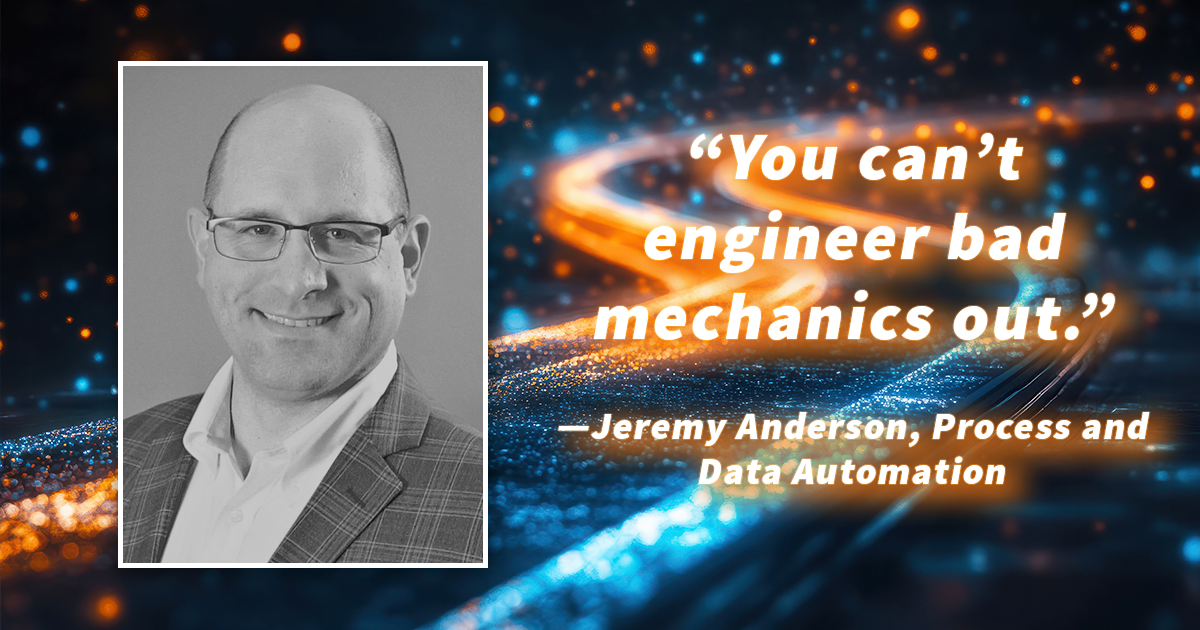
“You can’t engineer bad mechanics out of it,” he said. Controls can tune, smooth and compensate, but they cannot fully correct a weak physical or operational foundation.
Manufacturers considering AI, analytics or automation upgrades should define the problem, identify constraints and decide how success will be measured. The technology may be powerful, but it’s only one component of a broader system.
Integration is more than engineering
Anderson said the hardest change management work for integrators may lie outside engineering. Technology adoption is core to the profession, but companies also need deliberate operations, sales, legal and support capabilities.
“A lot of us go in thinking, if I just do great work, how could it go wrong?” he said. “But when things do go wrong, that’s when you fall back on those more operational functions.”
An automation incident can affect product availability, brand reputation and customer relationships, not just machine uptime. Risk-transfer mechanisms, including appropriate insurance and contractual practices, become part of business continuity. They should never be an administrative afterthought.
Customer expectations are evolving, as well. In food and beverage, where consumer preferences can change quickly, systems may need frequent upgrades for new flavors, sizes and packaging formats. Anderson sees a shift away from a transactional handoff.
“It’s less of the, ‘Here’s the SAT, thank you very much, sign here, good working with you,’” Anderson said. “[It’s] on to more of a longer relationship with the client, is what I see.”
That relationship depends on an engaged customer team. Anderson described the ideal customer as one with an astute but slightly undersized engineering staff — people who understand tradeoffs and can represent operator, quality and end-user needs.
Look beyond the scope
At CSIA, Anderson participated in a session called “The New R&D, Rip-off and Duplicate.” That playful title referencing thievery actually captures something that can be a huge asset in manufacturing. Instead of guarding secrets closely, peers should share what has worked, what has failed and how they solved difficult problems.
That’s why he loves the CSIA Conference every year. Even though system integrators are in a group full of what on paper looks like competitors, it actually ends up feeling more like a family reunion. The value, he suggested, comes from professionals’ willingness to offer practical advice and learn from each other’s experiences.
His advice to others is to cultivate peripheral vision.
“We understand what the primary challenge is, but it’s the peripheral vision,” he said.“That’s, I think, the differentiator between good companies and great companies.”
For manufacturers and integrators alike, that means scanning beyond the immediate scope to operator readiness, maintainability, support models, exposure to risk and the next disruption. It may not be the flashiest part of automation, but it is what helps technology deliver value on the plant floor.
The Ctrl+Alt+Mfg Podcast
Make sure to check out other episodes of the Ctrl+Alt+Mfg podcast, where hosts Gary Cohen and Stephanie Neil discuss a range of digital transformation insights. The last five episodes are listed below:
Ep. 16: The system integrator playbook, with Daniel Gomez of Omnicon
Ep. 17: Rethinking Industrial Data, with Gary Tillery of Skkynet
Ep. 18: Audacious Goals for Infrastructure Security, with Danielle Jablanski of STV
Ep. 19: The Future of System Integration, with Daren Dieleman of Interstates