Systems leader Alicia Lomas explains how to turn “digital transformation” from a buzzword into measurable wins by starting with real problems, adding context to data and pairing software talent with controls expertise.
For years, “digital transformation” has been the manufacturing industry’s favorite buzzword — overused, underdefined and often misunderstood. But for Alicia Lomas, founder of Lomas Manufacturing and veteran of companies like Chobani and Redwood Materials, the moment has finally arrived when it’s more than just talk.
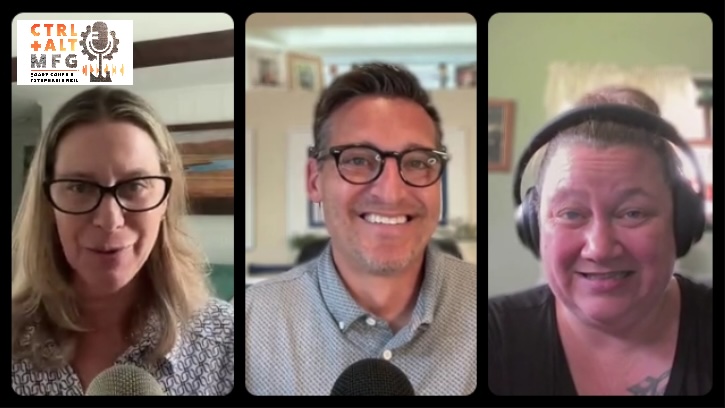
“Since Day 1, I’ve been at some factories that weren’t connected at all,” Lomas said on Episode 4 of the Ctrl+Alt+Mfg podcst. “Now everything can go over Ethernet, and we finally have the tools to do something meaningful with all the data we’ve been collecting for years.”
Across her career, Lomas has watched the evolution of plant floors, from isolated equipment to fully networked ecosystems. She said she believes the next leap won’t come from new technology alone, but from context, collaboration and curiosity.
From buzzword to business case
Manufacturers love the idea of digital transformation, but too often it starts with shiny new tools instead of specific problems to solve. Lomas said the first question should always be, “What are we trying to fix?”
Executives may focus on high-level metrics and platforms, while operators just need better information to make the right decisions on the plant floor. For her, digital transformation means connecting those worlds by turning data into insight that’s accessible and actionable.
“To me,” Lomas said simply, “it’s solving a problem.”
When companies start with the problem — whether that’s downtime, waste, inefficiency or poor visibility — they not only pick better technologies but also gain buy-in from the people who use them every day.
AI with a human in the loop
The conversation around artificial intelligence in manufacturing has shifted dramatically. Not long ago, it sparked fear about job loss; now, it’s about how AI can make jobs easier, safer and smarter.
Lomas envisions a future where control rooms operate like airplane cockpits, using smart systems to process vast amounts of data, and human operators to act as pilots verifying the AI’s recommendations.
“The power is to do the fancy modeling in the cloud, take all that information and send it back down to say, this is the proper set point,” she said. “You could save water if you used these valves differently.”
It’s not about replacing people, but about augmenting their decisions. The human remains the final authority, ensuring that machine intelligence aligns with real-world context.
Context is king
Data, by itself, doesn’t solve problems — context does. Lomas has spent much of her career building that context through structured data naming, unified namespaces and well-designed digital architectures that make information meaningful across systems.
She’s seen firsthand how poor data hygiene leads to chaos. When every tag, valve and sensor follows a standard, however, analytics become faster, reports become accurate and AI becomes truly useful.
“If you put data in that is junk and you don’t know what it is, you’re going to get junk out,” she said.
This approach may not grab headlines, but it’s the foundation for everything from predictive maintenance to real-time optimization.
Collaboration is the competitive edge
For all the talk of AI and automation, the biggest barrier to progress is often cultural. Misalignment between IT, OT and software teams can stall even the most promising projects.
Lomas has played mediator between those groups, translating between process engineers, software developers and cybersecurity teams. Her message is that the best ideas die without collaboration.
She summed it up with characteristic directness
“Throw your ego out the door,” she said. “Let’s solve some cool problems.”
That means creating cross-functional teams with shared goals (e.g., pairing software engineers with controls veterans who know the process inside and out). When they work together, companies innovate faster and deploy more reliably.
Building the next generation
Lomas is just as passionate about mentoring as she is about machinery. She’s made it a mission to bring more women and young engineers into manufacturing, coaching them to stay curious and get away from the screen.
“Get out from behind your desk,” she tells new engineers. “Talk to operators. Understand what the machines are doing.”
It’s advice she’s followed throughout her career, and it helps ground her approach to technology — learn by doing, connect by communicating and never stop asking questions.
Her new podcast, WOMANufacturing, continues that mission by offering a candid space for women in engineering to share their experiences, celebrate successes and navigate the realities of the industry.
The moment is now
For Lomas, digital transformation isn’t some futuristic vision. It’s here now, but only if we approach it with the right mindset. That means understanding the data, empowering the people and breaking down silos between the ones and zeros.
“Controls engineers have been quietly building this foundation for years,” she said. “Now it’s time to connect the dots, bring everyone to the table and make it real.”
The Ctrl+Alt+Mfg podcast
Make sure to check out the first few episodes of the Ctrl+Alt+Mfg podcast, where hosts Gary Cohen and Stephanie Neil discuss insights from WTWH Media’s State of Industrial Automation Report – Spring 2025, how to create clean, connected and trusted data and why industrial cybersecurity isn’t just an IT problem.