Interact Analysis projects the packaging automation market to grow from $5.1B in 2024 to $7.5B by 2029.
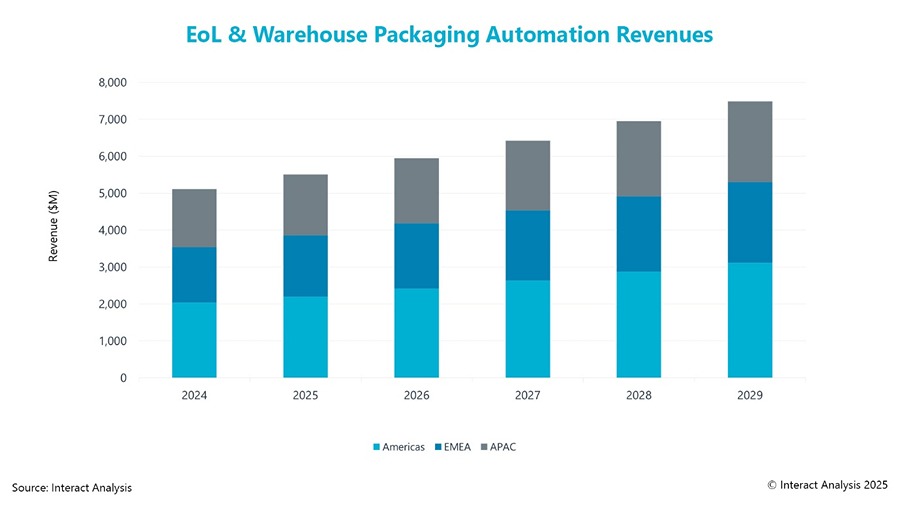
The global end-of-line (EoL) and warehouse packaging automation market is projected to grow at a compound annual growth rate (CAGR) of 7.9% forecast between 2024 and 2029, according to Interact Analysis. The report forecasts the market value will rise from $5.1 billion in 2024 to $7.5 billion in 2029, with the Americas region and warehouse packaging automation expected to contribute to this growth.
Control Engineering analysis: Automated packaging and warehousing is an important expansion area for automation investments as growth continues with online shopping and fulfillment and as companies seek to reduce costs related to product distribution. Wise investments in automation for packaging and end-of-line applications also help resolve labor shortages in manufacturing, warehousing and logistics sectors, allowing workers to be trained in more fulfilling, less-manual positions. Automation helpful to these applications include robotics with application-specific end effectors, machine vision and other position sensors, motion controls, artificial intelligence processing capabilities to improve speed and accuracy, human-machine interfaces, industrial networking and system integration controls and automation engineering design.
Companies in the Americas and Europe are increasing investment in warehouse packaging automation in response to rising labor costs. Both regions are also seeing growth in end-of-line packaging systems for the manufacturing industry as labor costs and regulatory requirements persist. In the APAC region, most growth is driven by overall expansion in the manufacturing sector rather than rising labor costs.
Manufacturing vs. warehousing in automated packaging
According to Interact Analysis, end-of-line manufacturing packaging automation accounted for 61% of revenues within the EoL and warehouse packaging sector in 2024. This share is expected to decrease slightly to 60% by 2029, while warehouse packaging is projected to grow at a faster rate. End-of-line manufacturing applications, such as case packers, case sealers and case erectors, represented combined revenues of $2.1 billion in 2024.
Growth in warehouse automation is primarily driven by increasing investment in right-fit boxers, bagging machines and robotic palletizing. E-commerce requirements and legislation aimed at reducing material waste are key factors. Although right-fit boxers and baggers have the highest growth rate, their market size remains relatively small compared with more established solutions.
Vanessa Lopez, research analyst for Interact Analysis, explains: “Amazon has supercharged the expectation for automatic right-fit boxers across our forecast period. The company has announced the deployment of right-fit boxers across all its European facilities.
“Packaging automation is more mature within manufacturing environments. New machinery deployments are usually seen in newly-built facilities or where an increase in throughput is needed. However, in the warehousing sector, many packaging processes are still carried out manually, so there is greater opportunity for machine vendors here. That is why we expect higher growth in sales for warehousing applications during the forecast period.”
Edited by Puja Mitra, WTWH Media, for Control Engineering, from an Interact Analysis news release.