Water and wastewater measurement and flow technologies at Weftec 2025 in Chicago included electromagnetic flow meters, ultrasonic flow meters, Coriolis flow meters, variable area flow meters, ultrasonic level meters, level meters and switches.
Krohne showed water and wastewater measurement and flow technologies at Weftec 2025 in Chicago. Krohne products include electromagnetic flow meters, ultrasonic flow meters, Coriolis flow meters, variable area flow meters, ultrasonic level meters, level meters and switches, explained Joseph Incontri, Krohne director of marketing. With focus on reliability, efficiency, safety and availability, Incontri said, Krohne has been providing measurement technologies since 1921. U.S. facilities include Houston and Beverly, Massachusetts.
Clamp-on ultrasonic flow meters

Clamp-on ultrasonic flow meters (Figure 1) save set-up time with automatic sensor alignment.

Ultrasonic gas transducers (Figure 2) look at transit time of signal across the pipe. They can be more accurate than differential pressure measurements using an orifice tube which can be prone to clogging. Biogas applications can be difficult to measure. This provides a linear output without conversions.
Low-flow, closed pipe magmeter measurements


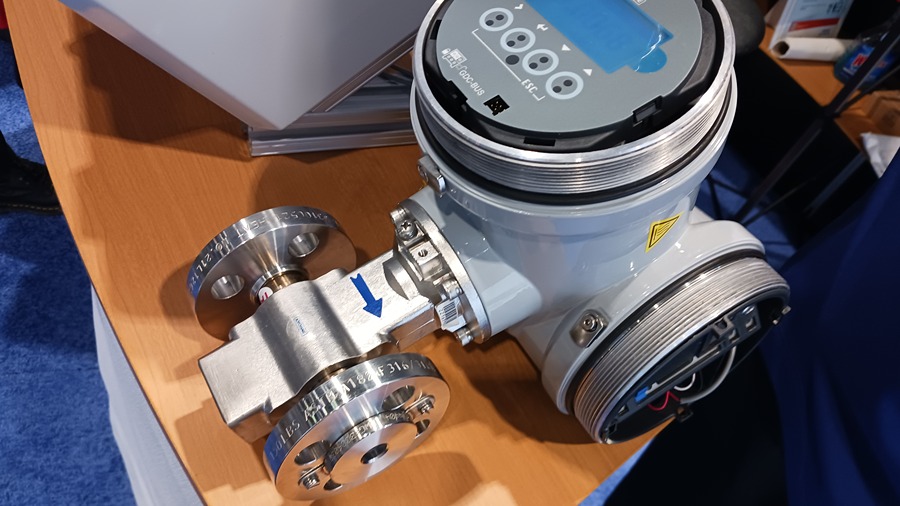
Tidalflux (Figure 3 and Figure 4) available for more than 30 years (since mid-90s) provides closed-pipe magmeter accuracy where the pipe is 10% to 100% full, for applications that previously would require open-channel flow measurements, Incontri explained. The meter is calibrated in the factory, saving time onsite. The Tidalflux 2300, electromagnetic flowmeter for applications with partially filled pipes, integrates capacitive level measurement for flow measurement of water and wastewater (≥10% pipe fill level). It is accurate (±1%) and is a cost-saving alternative to open channel systems. It is available in flange size DN200 to DN1600, 8-inches to 64 inches. Communications include 20 mA, pulse, HART, Modbus and Profinet.
Custody transfer electromagnetic flow meter

The Waterflux 3070 electromagnetic flow meter (Figure 5) provides district metering for potable water and custody transfer measurements. It has battery or line powered with battery backup option. It integrates temperature and pressure measurement for leak monitoring and has bi-directional flow measurement capability over a wide dynamic range. It is IP68 rated enabling burial applications as needed. Among other features, it has:
- Unique rectangular sensor design for good low flow performance
- Available with patented reference electrode: no grounding rings needed
- High accuracy at peak flows during the day and at low flows during the night.
Radar meter: non-contact level measurements

An Optiwave radar meter (Figure 6) provides high accuracy high performance for same or less price than ultrasonic flow meters, without effect on measurement accuracy from vapors. Several models are available, depending on whether accuracy within ¼-in. or 1/8-in. is needed. The Optiwave 1540 is a radar level transmitter for basic applications with liquid chemicals and open-channel flow. It provides cost-effective non-contact level measurements up to 5 bar / 72.5 psi with high accuracy requirements. It is compact and robust 80 GHz radar with flush-mounted PVDF lens antenna [a polyvinylidene fluoride lens shapes and directs electromagnetic waves]; waterproof (IP68) version is available. It can be used for level measurement and as a flow transmitter. Communications via 2-wire is 4-20 mA and HART 7, with user-friendly commissioning via Bluetooth using the Krohne Opticheck Level Mobile app.
A magmeter for irrigation applications has a battery that can last up to 15 years, depending on application sampling rate. An added magmeter benefit of higher cost in relation to mechanical meter is that magmeters have no moving parts to wear out. Up to 24-in. diameter is available. Also, no straight run is needed. Temperature and pressure also can be measured if needed.
Straight Coriolis mass flow meters: Less corrosion

Coriolis mass flow meters are available in three straight designs (Figure 7) accommodating diameters of ¼-4-inch, 6-10-inch and 12-16-inch pipes. The designs use straight, not bent, measurement tubes, allowing fewer corrosion opportunities than bent-pipe designs.


Measurement technologies are adapting to digital communication (Figure 8) and wireless needs, with wired and wireless protocol options available. A demonstration showed communications option from a meter to an enclosure (Figure 9).
Edited by Mark T. Hoske, editor-in-chief, Control Engineering, WTWH Media, [email protected].
Keywords
Industrial flow meters, industrial level sensors, Weftec 2025
Consider this
Are you using the best sensors for the process measurement application?
You also might like