SCADA lifecycle standard, ISA112, part 1, standardizes terms and provides a diagram for the lifecycle of a supervisory control and data acquisition system, as explained by a committee member at the ScadaFest 2026 event by Trihedral.

SCADA lifecycle standard insights
- SCADA lifecycle standard, ISA112, part 1, standardizes terms and provides a diagram for the lifecycle of a supervisory control and data acquisition system, as explained by an ISA112 committee member at the ScadaFest 2026 event by Trihedral.
- ISA112’s goal is to develop a series of ISA standards and technical reports that provide guidance for system design, implementation, operation and maintenance of SCADA systems for pipelines, water and wastewater, power, oil and gas and other industries to support the overall integrity and reliability of these systems.
- A core contribution is that ISA112 treats SCADA as a long-lived operational asset, rather than a one-time capital project, defining standard lifecycle phases and continuous work processes.
Part 1 of the new standard for supervisory control and data acquisition (SCADA) lifecycles provides terminology and a diagram explaining the power and usefulness of SCADA for training, machine learning, optimization of operations, cloud and service-based architecture, according to Steven Gillan, ISA112 standards committee member and associate, automation lead PBX Engineering Ltd., at ScadaFest 2026 event by Trihedral, a Delta Group Co.
Gillan provided an overview of the standard and primer on newly published consensus standard SCADA Systems – Part 1: SCADA Lifecycle, Diagram and Terminology.
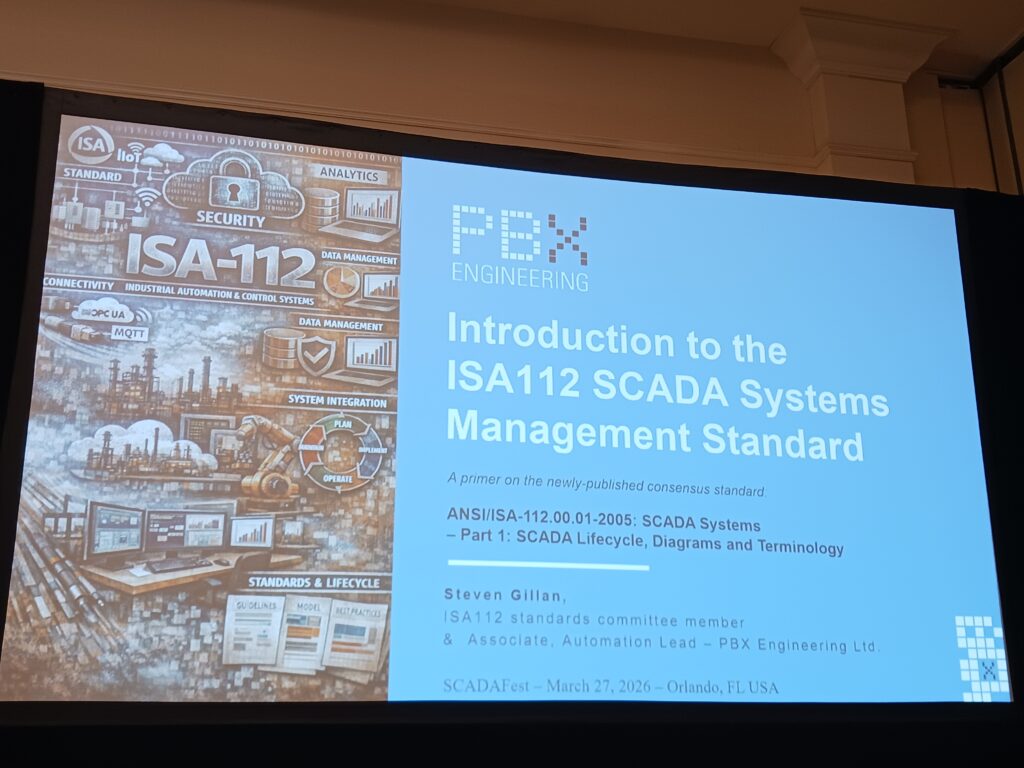
The ISA112 committee’s goal is to develop a series of standards and technical reports that provide guidance for system design, implementation, operation and maintenance of SCADA systems for pipelines, water and wastewater, power, oil and gas and other industries to support the overall integrity and reliability of these systems. (Part 1 of the standard, ANSI/ISA-112.00.01-2025 (Figure 1), is available for purchase and included with ISA member access.)

Gillan, a voting member of ISA112 SCADA Systems standards committee and a member of ISA101 HMI Design Standard, said ISA112 (Figure 2) is a consensus-based committee with more than 350 registered members. Committee members include end users, control software vendors, hardware vendors, engineering firms, system integrators, consultants, distributors, educators and government entities across many industries and geographies.
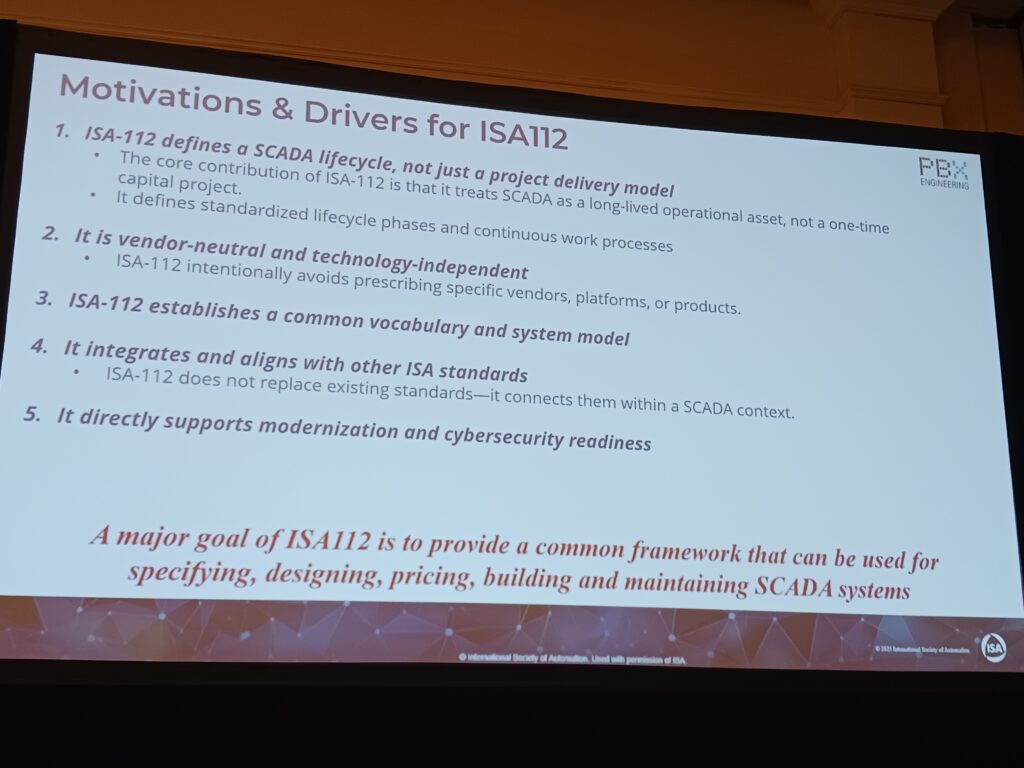
Motivations and drivers of ISA112
Gillan said the committee’s core contribution is that ISA112 treats SCADA as a long-lived operational asset, rather than a one-time capital project, defining standard lifecycle phases and continuous work processes (Figure 3). Because a SCADA system may last more than 30 years with multiple expansions, it’s important to avoid vendor lock-in and inconsistent design philosophies, he said. With technology independence, it’s important to establish a common vocabulary and system model. ISA112 integrates and aligns with other ISA standards, connecting them within a SCADA context. ISA112 also supports modernization and cybersecurity readiness.
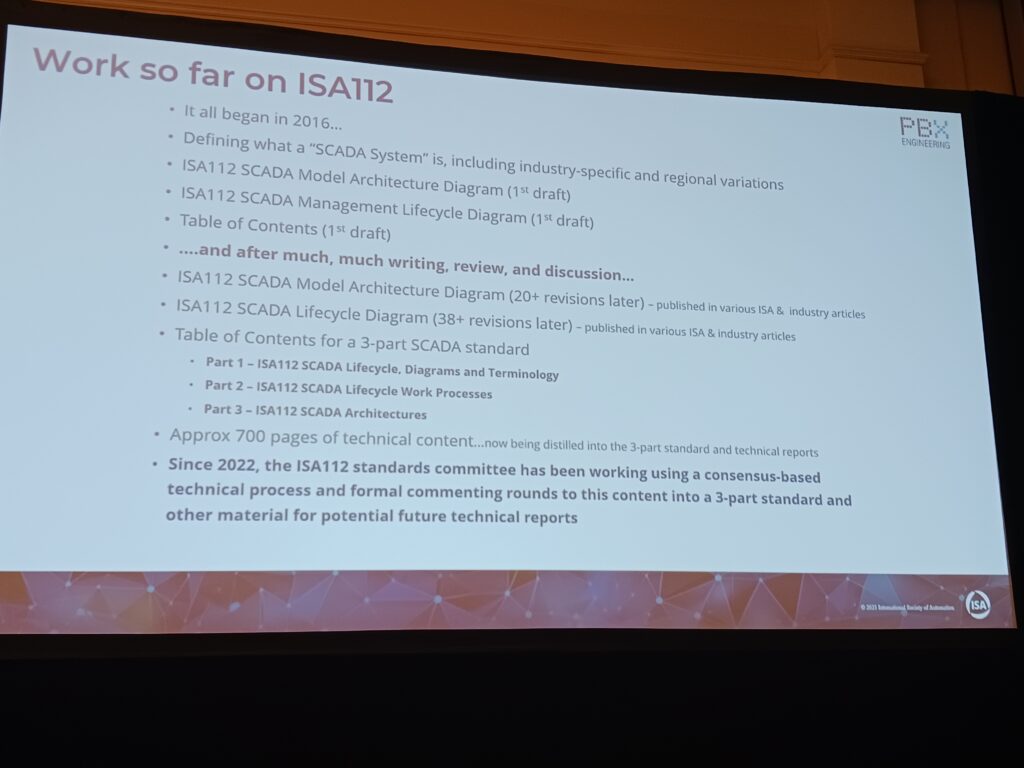
ISA112 progress, plans
The ISA112 effort began in 2016, Gillan said, by defining what a SCADA system is, including industry specific and regional variations. The SCADA architecture was completed after 20 revisions; after approximately 38 revisions, the lifecycle was completed.
About 700 pages of technical content will be distilled into three parts.
Part 1: ISA112 SCADA Lifecycle, Diagrams and Terminology (available February 2026)
Part 2: ISA112 SCADA Lifecycle Work Processes (perhaps in 2027 or 2028)
Part 3: ISA112 SCADA Architectures (perhaps in 2028 or 2029).
Technical reports will follow, providing more guidance (Figure 4).
What is a SCADA system?
For a standard to be useful, the definition must be broad, he said. ISA112 defines SCADA as follows.
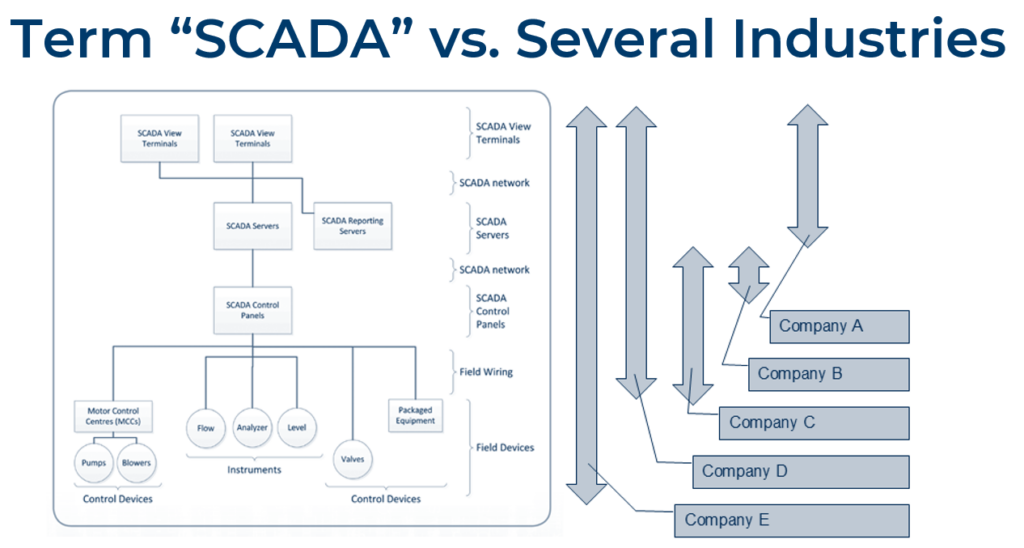
“SCADA = a system which is a combination of hardware and software used to send commands and acquire data for the purpose of monitoring and controlling.” The standard acknowledges, “Different industries use the term SCADA to mean many different things that are specific to that individual industry. Each of these industries is correct in how it uses the term SCADA within its own context. We must be aware of these, and our definition and standard must be written so that it can be used by all industries.”
Even among industries, regions and end-users, SCADA application may differ, taking portions or all of the model, top to bottom (Figure 5).

The system architecture diagram (Figure 6) aligns with the Purdue model for control design and adds a level 5, for cloud-based software-as-a-service external applications. This is a convergence point for information technology (IT) above and operational technology (OT) below, Gillan said.

The ISA112 lifecycle diagram (Figure 7) shows activity group and descriptions, 1-7, includes:
- Continuous work processes
- System standards
- Design, system development
- Hardware build/fabrication
- Installation/deployment
- Commissioning/startup
- Operate.
Tradeoffs are always present in system development, but having documentation visible can help prevent local optimizations that create global problems, Gillan said.
The ISA112 committee is aligned into organizational roles to split types of work.
Because most SCADA failures are organizational, not technical, there’s a need to:
- Support repeatability and consistency across projects.
- Scale across multiple projects
- Craft activity to a repeatable system
- Clear audit and review points, with post-project lessons learned
- Make it defensible for regulation, insurance and leadership.
SCADA continuous work processes
Continuous work processes are reflected in ISA112, with governance of who owns, uses, pays for and maintains the SCADA system. Governance requires a written policy endorsed by management.
Long-term planning of a SCADA system can include five years to more than 25 years. Some may integrate a SCADA master plan.
Security includes physical, operational and cybersecurity.
Documentation needs to be up to date for operations and maintenance.
Management of change includes managing, controlling and documenting system changes.
Verification means periodically changing that the SCADA system works as documented.
An audit is periodic checking that work processes are followed and documented.
SCADA system standards
ISA112 describes SCADA system standards in seven areas.
1. Each SCADA will have owner-specific attributes, depending on need, covering SCADA philosophy; availability and reliability; platform; safety standards; security standards, guidelines and procedures; network / architecture guide; equipment I/O interface standard; packaged systems interface standard; panel design standard; field wiring / wire labelling standard; data point tagging standard; equipment tagging / naming standards; HMI philosophy and HMI style guides (ISA101.01); alarm philosophy (ISA18.2); event processing, logging and messaging guideline; process control narrative templates/guidelines; programming / configuration guides; programming / alarm / configuration templates; data collection / data storage / historian guide; SCADA to business integration / data sharing philosophy; data reporting standards; computer-aided design (CAD) / drawing standards; documentation standards; management of change (MoC) procedures document; system environment requirements; SCADA work procedures; approved equipment list, equipment specification templates; additional design standard; and installation standards.
Some areas above have multiple levels of detail not shown. For example, field wiring / wire labelling standard has nine entries. The idea, Gillan said, is to get what you want, not just do what you want. Items two through seven are listed below without details, although do include many details, similar to above.
2. SCADA design work processes
3. System SCADA programming and hardware build-system development
4. System SCADA programming and hardware build-hardware build / fabrication (including PLC panels and control consoles)
5. SCADA install / deploy, commission, operate – Installation / deployment
6. Commissioning / startup
7. Operate.
As part of the documentation review, the committee paid particular attention to the difference between recommendations (“should”) and requirements (“shall”), Gillan said.
Technical reports will follow with how to do what the standards describe (implementation guidance) in new or brownfield sites and within industries and applications, he added.
Mark T. Hoske is editor-in-chief, Control Engineering, WTWH Media, [email protected].
Keywords
ISA112, supervisory control and data acquisition, SCADA standard
Consider this
Is engineering a SCADA system easier and lifecycles more understandable with agreed-upon terms and architecture?
You also might like
New SCADA lifecycle standard supports system modernization – ISA says ANSI/ISA-112.00.01-2025 is available for purchase and included with member access.
New SCADA functions, 50 new features – New features for supervisory control and data acquisition (SCADA) software include a space-saving historian, easier license activations, more power reporting functions and smarter communication capabilities, explained at ScadaFest 2026, hosted by Trihedral, a Delta Group Co.