Beckhoff's web-based tool allows engineers to build and use artificial intelligence (AI) models without specialized data-science knowledge.
At Pack Expo Las Vegas, Beckhoff Automation demonstrated TwinCAT 3 Machine Learning Creator, a web-based tool that allows engineers to build and use artificial intelligence (AI) models without specialized data-science knowledge.
Users can provide training data, such as labeled images showing good parts, irregularities or color deviations, to the no-code platform to automate time-consuming programming. The software then identifies the proper AI model and manages the processing, while training, evaluating and fine-tuning the model for accuracy and real-time control applications.
“Most people who are control engineers are not machine learning experts,” said Casey Taylor, software product manager at Beckhoff, during an interview with Control Engineering. “They’re really struggling. We wanted to build a tool that somebody who wasn’t a machine learning expert could come in and build.”

Rock-paper-scissors demonstration
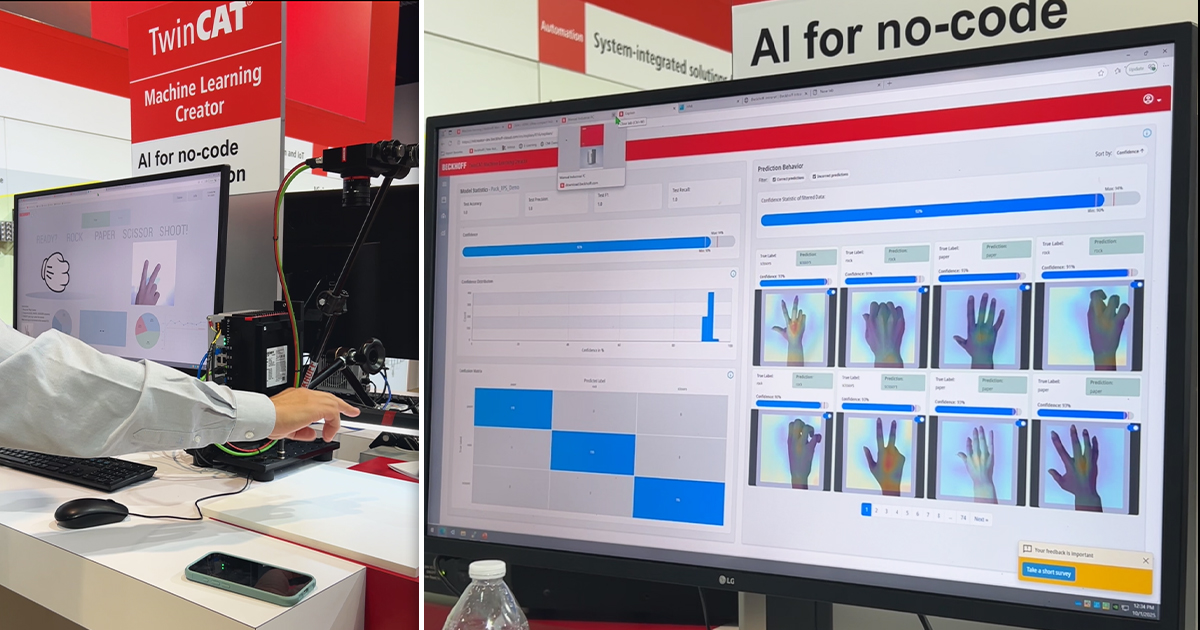
Taylor demonstrated the tool using generated data from rock-paper-scissors hand gestures.
“We’re using a human machine interface (HMI) to demonstrate the output of what you’d use Machine Learning Creator for. We’ve got a rock-paper-scissors game where you can indicate with your hand what you’re throwing. You can see the signals of the different things you throw, even a little game you can play against the computer,” said Taylor, adding that the demo showed how the system reacts in real time.
The system generates models in ONNX format, making them compatible with third-party systems while remaining optimized for Beckhoff Industrial PCs. Each model includes a PLCopen XML file with IEC 61131-3 that can be imported directly into TwinCAT for execution.
The system is built as an extension of TwinCAT XAE (Extended Automation Engineering) and connects with TwinCAT XAR (Extended Automation Runtime) to execute trained models directly within automation environments.
Model training, format and adoption
Machine Learning Creator can be used for various types of data, including categorization and defect detection.
“You can train on labeled data for categorizing, in this case, three different labels, or on defect detection,” he said. “We run those models in real time on the hardware right with TwinCAT.”
Taylor shared two examples of deployments. The first involved a customer needing to detect defects in the rings it produced.
“They provided a bunch of samples of quality rings and ones that had failed, either the saw had cut and damaged it or a weak section in the material,” he said. “The system is able to successfully identify those and categorize poor quality or products that might need rework.”
Additionally, he shared a second dataset that focused on the quality of food production. “It’ll detect dirty eggs and cracked eggs,” he said. “We can have that in line with the system and identify those as they’re coming through.”
In both cases, engineers trained the system by providing hard data of good and bad examples, allowing it to classify products that need rework or removal in real time.
Beckhoff is also encouraging its customers to begin collecting their own process data. “If you’ve got a system that’s putting through material, start gathering the data today. The more data, the better,” he said.
Cloud-based service and availability
Running as an online service, users log in to Machine Learning Creator and upload their models, which are processed on Beckhoff’s servers because of the high computing power required.
According to Taylor, access is subscription-based. “You can buy a year and get so many hours,” he said.
Currently in beta testing, the TwinCAT 3 Machine Learning Creator platform consists of different product packages related to access, computer vision and computing capacity. The product platform is expected to launch in the fourth quarter of 2025, the company said.