System integration experts provide more about “Motors, drives: How to better manage energy with variable speed drives,” also the name of the Dec. 11 Control Engineering and Plant Engineering webcast. Below the two instructors for the course answered more audience questions than webcast time allowed.

Industrial controller selection insights
- Explore industrial energy saving variable speed drive advice from system integrators experts, also instructors in a December Control Engineering webcast. The instructors answer more than 20 audience questions in this article.
- Understand how variable speed drives save energy and learn where an industrial variable speed drive can save energy in various applications.
- See the webcast for more advice: Register for the Control Engineering webcast, “Motors, drives: How to better manage energy with variable speed drives,” archived until Dec. 11, 2026.
Industrial drive experts provide more answers about “Motors, drives: How to better manage energy with variable speed drives,” after the Control Engineering and Plant Engineering Dec. 11 webcast that will be archived for a year. Audience listening live had the opportunity to submit questions to presenters. Some answers include information on motor-drive applications, sizing, shielding, harmonic mitigation, motor-drive lifecycles and reliability and other topics.
Webcast instructors help with energy saving drives
The experts (Figure 1) in the energy efficiency webcast and providing the extra answers were:
- Michael Daugird, director, facility design and engineering, ACS
- Roger Manrique, automation specialist, GreyLogix Brazil
The learning objectives for the webcast were:
- Identify variable frequency drive (VFD) features, functions and applications for improved energy management.
- Assess VFD energy management and the questions to ask to improve selection, integration, application and use through the VFD and motor-drive lifecycle.
- Understand VFD application examples demonstrating quantified energy savings for smarter energy management.
More than 20 audience questions and answers from the instructors follow.
Motor speeds in industrial applications
Is it typical that motors in industrial applications without VFD/VSDs are running at 100% speed, or are there other ways they are typically set up to run at ~80% speed?
Manrique: Unfortunately, yes, that’s the reality in most plants. When a motor is connected across-the-line without a VFD, it’s a constant speed machine. It will run right up against its rated speed, which is set by the line frequency and the motor’s inherent slip. Getting down to 80% speed is almost never done electrically. Instead, we see mechanical methods: throttling valves on pumps, discharge dampers on fans, or clutches and gearboxes on conveyors. The problem is that all these mechanical methods are wasting energy. You’re forcing the motor to run at full speed and burning off excess energy and flow through a restriction. That’s the core value proposition of a VFD: it reduces the speed directly, which cuts the power consumption right at the source.
Help with calculations for energy saving drives
Do you have any recommendations for calculating energy savings? We frequently are asked to justify the cost of installing a VFD, and our methodology is not consistent across teams and individuals.
Manrique: For all serious justifications, you should always use a bin analysis spreadsheet. This is the only way to accurately account for the non-linear power curve. The average speed method looks great in a presentation, but it will cause inconsistencies in a real-world analysis. You need to break the operating hours into “bins” of speed or flow demand. This is easy to do if your process already has a historian, HMI, or supervisory system logging data. For a practical example like a pump, you can record the throttling valve positions over a period. With that data, you can apply the Affinity Laws for pumps and fans to estimate savings. For linear loads (like conveyors), you can use a linear savings rule across those same bins in your spreadsheet. Consistency across teams is key here; the bin analysis is the industry standard for a reason.
An indirect VFD-related energy question
I know manufactured VFD cable is supposed to reduce EMI / RFI noise, but are you aware of any energy savings realized by using VFD cable?
Manrique: Using VFD-rated cables is not about energy savings, but about system reliability and EMC. Such cables are designed to handle the high rate of voltage change (high dV/dt) from the drive’s IGBTs, provide a symmetrical ground path, and minimize radiated and conducted EMI/RFI noise. From an energy standpoint, the difference in copper losses or resistance is negligible. The real value of this specialized cabling is preventing nuisance trips, reducing sensor interference, mitigating the risk of motor bearing currents, and protecting the motor’s insulation from premature failure. It’s a reliability investment, not an energy one.
Electromagnetic shielding with motors and drives
For long conductor runs between drives and motors, such as several hundred feet, are shielded conductors recommended?
Manrique: Short answer: Yes, shielded cable is the standard for EMC and reliability. However, you need to be aware of the trade-off. Shielded cable has higher capacitance, and that increased capacitance puts a heavier load on the drive’s IGBTs and DC bus. This is why drive manuals always specify shorter maximum cable lengths for shielded cable. If you run it too long without protection, you risk premature drive failure or constant overcurrent trips. If you need a long run, say, several hundred feet, do not swap to unshielded cable just to gain distance. Instead, you must install an output reactor right at the drive terminals. For extreme lengths or highly sensitive applications, you should step up to a dV/dt filter or a full sine wave filter. Always check the specific footage limits in your drive manufacturer’s manual; they vary significantly between models.
VFD application question
Do you recommend using a VFD with a large gantry machining mill spindle motor, or is it too challenging to incorporate a VFD?
Manrique: It’s absolutely possible to use a VFD, but the application dictates the complexity. Spindles are a perfect application for a VFD because they require precise speed control and often need constant torque at low speeds for heavy cutting. However, you must use a closed-loop vector control setup, which means installing an encoder or a resolver on the motor shaft for feedback. This requires careful tuning of the torque and speed loops during commissioning. In high-performance machine-tool applications, dedicated spindle drives or servo solutions are often preferred because they offer better dynamic response and rigidity. The decision should always be based on the required dynamic performance and precision, not just the motor’s power rating.
Help with VFDs and electrical discharges
What about VFDs gives us fluting on bearings, and what would we use to remedy that?
Manrique: The issue is the high-speed switching of the VFD’s output, known as pulse width modulation (PWM). This switching creates a common-mode voltage that can induce a voltage on the motor shaft. When that voltage builds up high enough, it discharges through the path of least resistance—the motor bearings—causing microscopic electrical discharge machining (EDM). Over time, this pitting develops into the characteristic washboard pattern we call fluting. The best field solution is usually a combination of two things: a shaft grounding ring to safely divert the shaft voltage and ensuring you have excellent cable and shield grounding back to the drive and panel.
Where are industrial VFD application benefits?
What are typical applications that benefit from a VFD?
Manrique: VFDs add value in any application where:
- Speed needs to vary with process demand.
- The process is currently using mechanical throttling (valves, dampers) to control flow or pressure.
- You need a soft start or controlled stopping profile to protect mechanical equipment.
- Process control, repeatability and product quality are critical.
The biggest and fastest energy savings almost always come from variable torque loads like fans and centrifugal pumps, due to the cubic relationship between speed and power.
Can advanced vector control help variable torque applications?
Are there any variable torque applications that would benefit from advanced vector control?
Manrique: While simple V/Hz control is often sufficient for basic fans and pumps, advanced vector control (field-oriented control) definitely adds value in certain variable torque applications. Specifically, when you need to operate reliably at very low speeds (where V/Hz struggles with torque), or when the process requires extremely high torque accuracy and fast response. For example, if you have a critical pressure or flow loop that must be tightly regulated, vector control provides the dynamic performance needed. Also, from an efficiency standpoint, if you have an oversized or lightly loaded motor, vector control can minimize rotor losses, making the entire system more efficient than V/Hz.
Harmonic mitigation with VFDs
What are you doing to limit harmonics from VFDs?
Manrique: The harmonic mitigation strategy is always a balance among compliance, system strength and cost. You don’t want to overengineer the solution. The baseline, and most cost-effective solution, is using AC line reactors (typically 3% or 5% impedance) on the input side of the drive. For larger systems, or when you need to meet stricter IEEE 519 standards, you need more advanced solutions:
- Passive harmonic filters: These are tuned LC filters that target specific harmonic orders.
- Active harmonic filters (AHF): These inject current to cancel out the harmonics, offering superior performance.
- Multi-pulse drives: Using drives with 12-pulse or 18-pulse input rectifiers instead of the standard 6-pulse significantly reduces harmonics by phase-shifting the input.
- Active front end (AFE) drives: These drives use IGBTs on the input side to draw a near-perfect sinusoidal current, virtually eliminating harmonics and allowing for regeneration.
- Daugird: The simple answer with DC line reactors is typically 35-40% THDi.
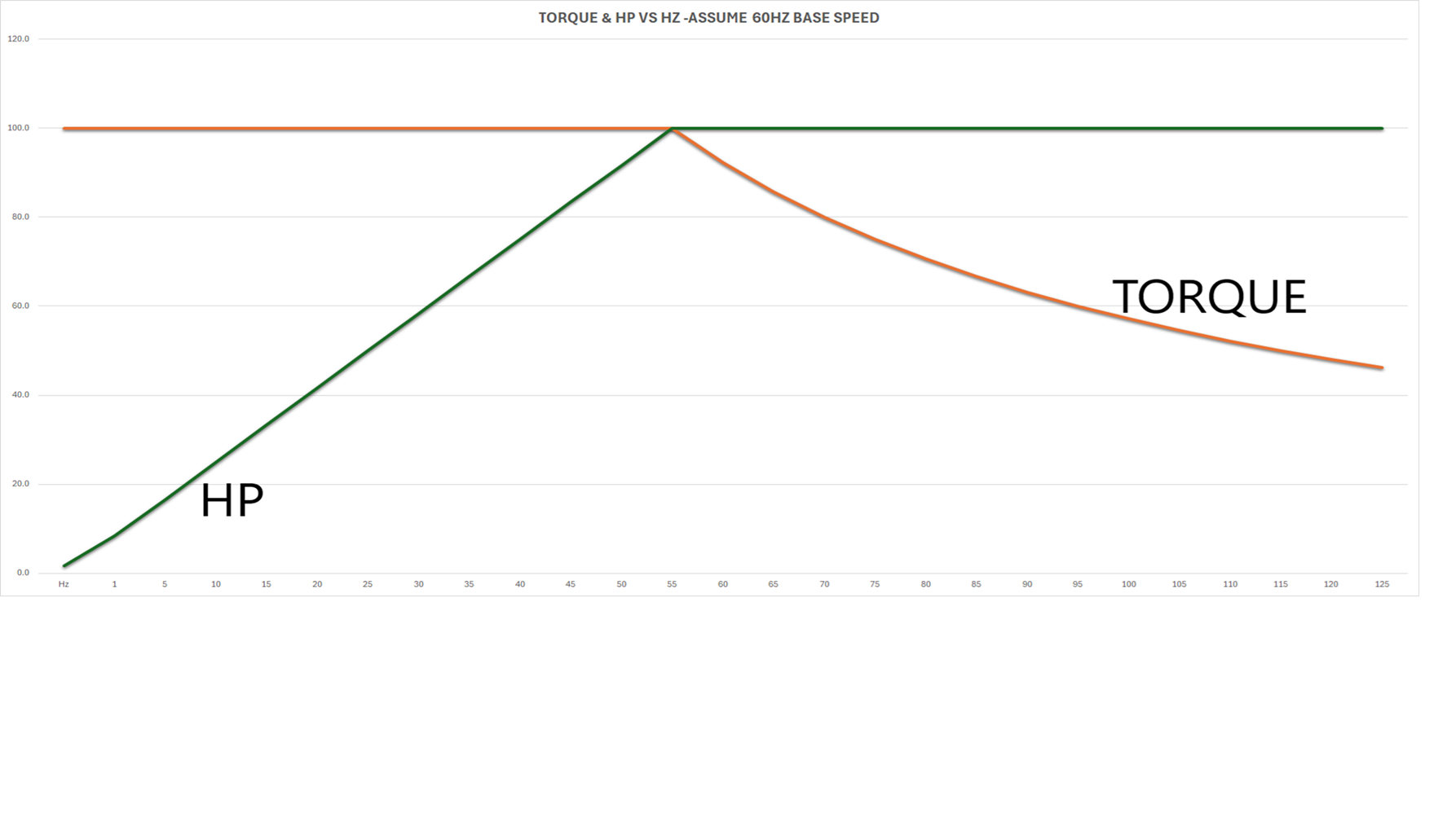
Figure 2: Typically, we would not operate at a speed that pushes below 50% torque (double speed) if it has a fan on the back of the shaft, explained Mike Daugird, director, facility design and engineering, ACS, in answering more audience questions after the Control Engineering and Plant Engineering webcast on “Motors, drives: How to better manage energy with variable speed drives,” a Dec. 11 webcast (archived for a year). Courtesy: Control Engineering webcasts
Motor reliability versus speed
When running a motor > 60 Hz, what should we look for in a motor to get the best reliability?
Manrique: Reliability at overspeed is primarily a mechanical limitation, not an electrical one. When you push past 60 Hz, you need to look for:
1. Mechanical overspeed rating: Does the motor manufacturer explicitly rate the motor for the speed you intend to run?
2. Bearing quality and lubrication: High speeds generate more heat. You need high-quality bearings (often angular contact) and proper lubrication for the higher RPM.
3. Rotor critical speed: Ensure your operating speed is not close to the motor’s critical speed, which will cause destructive vibration.
4. Balance quality: The rotor must be balanced to a tighter tolerance than a standard 60 Hz motor.
5. Cooling capability: Can the motor’s cooling fan (which may be less effective in the field weakening zone) or external cooling system handle the increased losses?
6. Insulation class: Ensure the winding insulation is rated for VFD use (inverter duty rated).
Is a motor voltage drop OK?
Is it acceptable for a 460 V motor (VFD driven) to run at around 440 V for a fan application? The voltage drop occurred after installing a sine wave filter to mitigate some issues. Any recommendations?
Manrique: Yes, running at 440V is generally acceptable, provided you keep a close eye on the motor’s current and temperature. When the voltage drops, the drive must increase the current to maintain the same power output. You must ensure the motor current stays below the nameplate full-load Amps (FLA). If the motor is running within its thermal limits and the current is acceptable, you’re fine. A key recommendation: Some high-end drives have specific parameters or a checklist for when a sine wave filter is installed. These settings allow the drive to automatically adjust its flux control to compensate for the voltage drop caused by the filter’s impedance, ensuring the motor runs optimally. Always check the drive’s manual for a “sine wave filter installation” section.
VFD lifespan
What is the expected lifespan of a typicial VFD? Is it more or less than typical motor life span?
Manrique: In the field, a typical motor lifespan is robust. We usually see 15 to 20 or more years of service, assuming proper maintenance and alignment. A typical VFD, however, has a shorter expected lifespan, usually 10 to 15 years. The reason is that the VFD has components that degrade over time. The “weak links” are almost always the DC bus capacitors (DC bus capacitors age based on heat and ripple current) and the cooling fans (which are mechanical and fail due to dust and wear). This difference in lifespan is exactly why a proactive preventive maintenance plan is critical for drives.
What is BEP?
Manrique: BEP stands for best efficiency point. This is the operating point where a pump or fan achieves its maximum hydraulic efficiency. Operating a pump far away from its BEP significantly increases energy consumption, introduces excessive vibration and accelerates wear on seals and bearings. The major benefit of using a VFD is that it allows you to adjust the pump’s speed to keep its operating point as close to the BEP as possible, even as demand varies. This maximizes efficiency and extends the life of the mechanical equipment.
Can VFDs help constant torque load applications?
What about constant torque loads? How much do they benefit from VFD integration?
Manrique: Constant torque loads (like conveyors, positive displacement pumps or extruders) see smaller energy savings compared to variable torque loads, but the benefits of VFD integration are still substantial. The value shifts from pure energy savings to control, reliability and process optimization. You gain precise speed control, controlled acceleration/deceleration (soft starting) and the ability to integrate the motor into complex control loops, which improves product quality and reduces mechanical stress on the equipment.
Using VFDs beyond 60 Hz in a ramp up
Is there a limit as to how fast/high we can ramp up a VFD beyond 60 Hz?
Manrique: The limit is not about the ramp rate itself, but about the available torque capability. Once you operate above 60 Hz, you enter the field weakening zone, and the available torque drops off rapidly. If you try to ramp up too fast, the motor will simply stall because it cannot produce enough torque to overcome the load’s inertia and friction. You must program the ramp rate to stay within the motor’s torque curve in that weakened field. As always, before pushing past 60 Hz, you must confirm the motor’s mechanical limits (bearings, balance and critical speed) are rated for the higher RPM.
VFD and motor sizing help
Years ago, we were taught to size the VFD to match the motor with HP equaling 100% VFD output at 60 Hz. Now, we see many HVAC motor drives operating well above the 60 Hz frequency, some as high as the mid-90 Hz range. How and why is this being done?
Manrique: This is a common trend, especially in modern HVAC systems, where the entire system is engineered from the start with VFD operation in mind. The primary reason is often cost and size reduction. By allowing overspeed operation, engineers can select a smaller, less expensive motor while still achieving the required maximum airflow, cubic feet per minute (CFM).
There are two main factors:
1. System design: Sometimes the ductwork is undersized, creating high static pressure. The fan simply needs to spin faster to deliver the required air volume.
2. Motor service factor: Modern motors often have a service factor (such as 1.15). Engineers use the motor’s constant horsepower (CHP) range above 60 Hz to get that extra speed. They accept the corresponding torque drop because the fan load is variable torque, and the motor’s thermal capacity (service factor) allows them to safely push the limits for short periods. It’s a calculated design trade-off to optimize capital cost.
Daugird: Direct drive allows us to operate at the BEP for the impeller/airfoil without the losses of a belt, shims or gearbox. The horsepower is the same, just like when we shimmed fans years ago. Then, we didn’t get more power out with the new RPM.
Voltage setting: Nameplate versus nominal system voltage
Using a Volts / Hertz model, should the voltage be set to motor nameplate (460 Volts) or nominal system voltage (480 Volts)?
Daugird: NEC recognizes 480V and that should be your setting. The 460V on nameplate tells you that as long as you get 460V to the terminals, you will get rated torque and performance. It should also be noted this isn’t enough of a difference to make a difference in practice.
Help with greater than 60 Hz operation
How should drives be programmed for greater than 60 Hz operation? Won’t Volts / Hertz exceed the DC bus voltage?
Manrique: You are correct; the voltage cannot increase beyond the drive’s maximum output, which is limited by the DC bus voltage. Above 60 Hz, the VFD maintains the maximum voltage (such as 460V) and continues to increase the frequency. This is called the field weakening zone. The critical thing to understand is that the motor’s torque drops inversely to the speed in this zone. You must verify that your load’s torque requirement at that high speed is still met. For variable torque loads like fans and pumps, the torque requirement increases with the square of the speed, meaning you often can’t run them much above 60 Hz without stalling the motor, unless the motor was significantly oversized.
Beyond electrical limits, you must check the mechanical limitations. Standard bearings have thermal and physical speed limits. A rotor balanced for 1800 RPM might vibrate destructively at 3600 RPM. While the internal fan spins faster, the core iron losses increase at higher frequencies, which can overheat the stator.
A common workaround, especially with European motors, is the 87 Hz technique. This uses a motor wound for a dual-voltage ratio (like 230V/400V). By connecting the motor in Delta for 230V, but supplying the VFD with 400V, you trick the system. The drive hits 230V at 50 Hz, but since the DC bus has 400V available, it keeps the ideal V/f ratio all the way up to 87 Hz (where it finally hits 400V). This gives you a significant constant torque boost up to 87 Hz.
Daugird: Not all motors are designed for 60 Hz. Defined-purpose motors allow us to specify the speed and operating voltage we want to run and control the torque curve. However, for a typical 60 Hz premium efficiency we enter what is called the constant horsepower region. Typically, we would not operate at a speed that pushes below 50% torque (double speed) if it has a fan on the back of the shaft. Direct drive motors in fan walls are often cooled because they are in a fan airstream, totally enclosed air over (TEAO). We also specify aux fan cooled motors for higher speeds, totally enclosed force ventilated or totally enclosed blower cooled (TEFV, TEBC). The graph (Figure 2) helps visualize this. You get 50% torque at 120 Hz to keep the HP constant.
Motor reliability over 60 Hz
When running a motor > 60 Hz, what should we look for in a motor to get the best reliability?
Daugird: TEAO if in an airstream or TEFV; TEBC when not. Specify bearings to 33% higher than you intend to run. Use one insulated bearing and a shaft grounding ring. VFD shielded cable also can help but we usually do that to prevent noise to other things. I have not seen a shield improve motor operation.
Voltage drop after a sine wave filter
Is it acceptable for a 460V motor (VFD driven) to run at around 440V for a fan application? The voltage drop occurred after installing a sine wave filter to mitigate some issues. Any recommendations?
Daugird: You will get less torque so you would derate the overall horsepower. Every VFD in operation outputs a lower voltage when running below base speed.
Constant torque VFD benefits?
What about constant torque loads? How much do they benefit from VFD integration?
Daugird: Vector drive operation improves their performance. It effectively shifts the torque speed curve to put the break down torque peak at the speed you are running by using the Clark-Park transform to calculate the vector of current in the rotor and vector of current in the stator. We can get 120% torque output when below 30 Hz regularly to increase spin up time for certain types of loads with vector control drives.
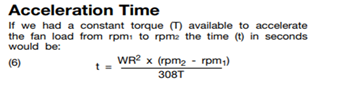
Figure 3: Formula shows the limit of a VFD beyond 60 Hz, said Mike Daugird, director, facility design and engineering, ACS, in answering more audience questions after the Control Engineering andPlant Engineering webcast on “Motors, drives: How to better manage energy with variable speed drives,” a Dec. 11 webcast (archived for a year). Courtesy: Control Engineering webcasts
VFD use past 60 Hz
Is there a limit as to how fast/high we can ramp up a VFD beyond 60 Hz?
Daugird: Yes, limited to the available torque of the motor and the inertia of the motor itself, and its load compounded by the mass flow of the load. See the formula (Figure 3 in imperial units).
Filters, VFDs and power quality
What filters are recommended to limit power quality issues such as harmonics and power factor?
Daugird: Ultra-low harmonic or active front ends are common to get tighter tolerances on harmonics.
12 and 18 pulse drives require special transformers to phase shift and their size, weight and footprint make them rare in current practice. They usually cost more, and I only see them for 4160V drives and above.
Edited by Mark T. Hoske, content manager, Control Engineering, WTWH Media, [email protected].
Keywords
Answers on industrial energy savings, variable speed drives (VSDs), variable frequency drives (VFDs)
Consider this
Are you getting the energy savings you need from motion control, pump, fan and HVAC applications?
See related article posted before the drives efficiency webcast.
https://www.controleng.com/motors-drives-how-to-better-manage-energy-with-variable-speed-drives/