Replacing a motor? Know key differences among IEC and NEMA motor standards to minimize risk of mismatching NEMA or IEC motor replacements in motor and motion control applications.

NEMA-IEC motor comparison insights
- When motor repair or rewind is not viable, a NEMA or IEC motor may be considered for replacing the other motor.
- Care must be taken when considering changing an IEC motor with a NEMA motor or a NEMA motor with an IEC motor because IEC and NEMA motor standards have key differences.
- Differences in IEC and NEMA motors discussed here include maximum supply voltage variation, current, maximum frequency variation, speed, design code, duty types, service factor and efficiency.
As the North American population of IEC motors continues to grow, two replacement scenarios have emerged for situations where repair/rewind is not viable. One is to replace the IEC motor with an available IEC equivalent (straightforward). The other is to replace the IEC design with a NEMA motor (or vice versa). The latter is a potentially more complicated conversion that should only be undertaken after careful comparison of the electrical, mechanical and physical characteristics of NEMA (National Electrical Manufacturers Association) and IEC (International Electrotechnical Commission) motors covered in this article.
For this discussion, we’ll first compare how IEC and NEMA handle applicable electrical characteristics and ratings before considering the respective mechanical and physical characteristics. Table 1 highlights key differences between IEC and NEMA ratings and tolerances for three-phase squirrel cage induction motors (SCIMs). Except for NEMA’s use of service factors (SFs) versus IEC duty types (S1 – 10), though, there are more similarities than differences in the two standards.
Electrical characteristics of EIC and NEMA motors
This section examines the electrical characteristics of voltage and frequency, current, efficiency, and speed, highlighting the similarities and differences between IEC and NEMA standards as they relate to motor design and performance. Although technically a mechanical property, speed is closely tied to a motor’s electrical design and is therefore included here.

Voltage and frequency: NEMA MG00001-12.44
Note: NEMA changed its Motors and Generators standard designation from MG 1 to MG 00001 in 2024, to follow IEC’s 5-digit numbering system.
The NEMA MG 00001-12.44 tolerance for voltage variation under running conditions is ±10% of rated voltage at rated frequency. At other than rated frequency, the absolute value of the percent of voltage variation, plus the absolute value of the percent of frequency variation, should not exceed 10%, provided the frequency variation is within ±5% of rated. NEMA MG 00001 also cautions that under those conditions, performance may not be in accordance with the “standards established for operation at rated voltage and frequency.”
Two examples of NEMA motor nameplate voltage
The following examples explain how to interpret and apply the NEMA MG 00001 motor nameplate voltage.
Example 1 looks at voltage variation at rated frequency for a motor rated 230V:
- Operation at +10% tolerance (230 + 23 = 253V) will increase stator core heating due to increased magnetic flux densities (magnetizing strength) and may increase full load current. For winding designs with relatively low magnetic flux densities (as in many premium efficiency motors), operating at +10% voltage may reduce the current, operating temperature and losses.
- Operation at -10% tolerance (230 – 23 = 207V) will almost certainly increase stator current and heating as the motor attempts to deliver the torque required by the load. For example, since output torque is proportional to the square of the voltage (V2), a motor operating at 10% below rated voltage (that is, 90%, or 0.9) would produce only about 0.9 x 0.9 = 81% of rated torque.
Note that the 230V rating in the above example matches that of some motors used on 208V systems. In that case, the system voltage is only 1V above the 230V motor’s rated minimum (230 x 0.9 = 207V), yet the system voltage could be as low as 190V–well below the tolerance for a 230V motor. This illustrates the importance of checking the system voltage against the motor’s rating to ensure proper application within its voltage tolerance.
Example 2 looks at voltage and frequency variation at rated frequency for a 460V motor.
The second case that NEMA MG 00001 describes is a variation of frequency and voltage. Although this scenario is almost nonexistent with utility-supplied power, it could occur with generated power.
For example, consider a 460V motor supplied by a generator operating below rated speed at 57Hz and 442V. The voltage is 4% below rated [1 – (442/460) = 1 – 0.96], and the frequency is 5% below rated [1 – (57/60) = 1 – 0.95], resulting in 9% (4% + 5%) total variation. While this is within its 10% tolerance, MG 00001 cautions that these variations may still affect motor performance.
Voltage and frequency: IEC 60034-1-7.3
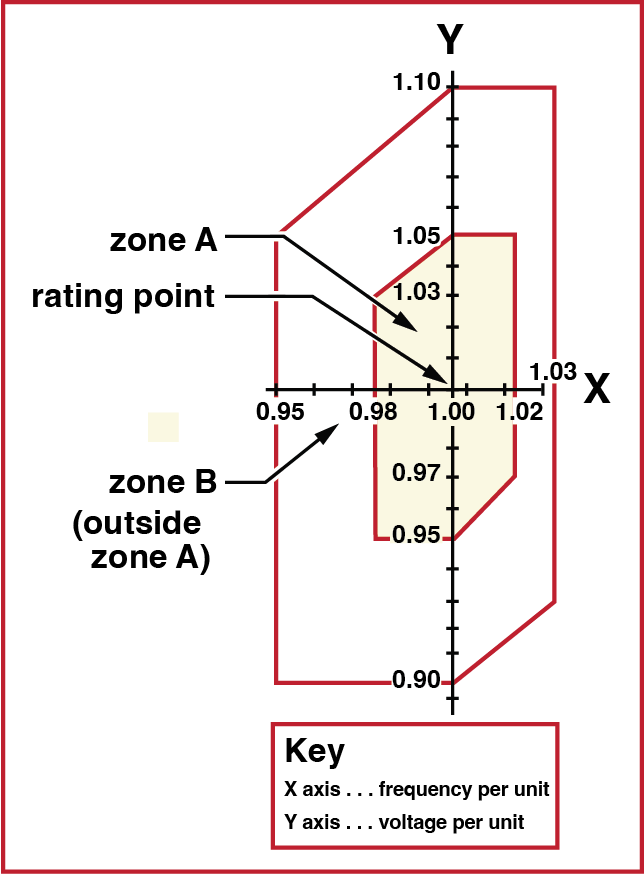
IEC 60034-1 also addresses variations from rated voltage and frequency but differs from NEMA MG 00001 by considering their combined, not individual, effects. It also uses a zone system, with zone A being more restrictive than zone B (see Figure 1). Within zone A, the machine must be capable of producing rated power; however, as with NEMA MG 00001, it “need not comply with its performance at rated voltage and frequency.” The IEC standard cautions, though, that the temperature rise may exceed that at rated voltage and frequency.
Regarding zone B, the standard implies it is not intended for continuous operation, noting that operation outside zone A “should be limited in value, duration and frequency of occurrence.” It also recommends derating motors for zone B operation.
IEC 60034 1 allows variation from rated voltage of ±5% (zone A) and ±10% (zone B) and ±2% (zone A) and +3%/-5% (zone B) from rated frequency.
Current: NEMA MG00001-12.47
The NEMA MG 00001 clause regarding the motor current (ampere) rating is short and to the point: When operated at rated voltage, rated frequency, and rated horsepower output, the input in amperes shall not vary from the nameplate value by more than 10%. That means the actual full-load current can be ±10% the nameplate rating. For example, if the motor nameplate rating is 100 amps, any value between 90 (10% less than 100) and 110 amps (10% greater than 100) could indicate a full-load condition.
Because the actual full-load current can vary from the nameplate value, the actual value may not accurately indicate the load on the motor. However, for most other purposes such as selecting overload protection, the nameplate current should be used.
Current: IEC 60034-1
Since IEC 60034-1 does not address current variation or specify a tolerance, it implies that the nameplate rated current is an exact value.
Speed (rpm): NEMA MG 00001-12.46
NEMA MG 00001 allows a seemingly liberal full load speed tolerance to account for material and manufacturing differences among identically rated motors. Specifically, it states that the variation “shall not exceed 20 percent of the difference between synchronous speed and rated speed when measured at rated voltage, frequency, and load and with an ambient temperature of 25°C.” However, the 20% variation is less significant than it appears because it applies to slip speed. Slip speed is the difference between the synchronous speed of the magnetic field produced by the stator windings and the physical speed of the rotor.
An example will illustrate the impact of the speed tolerance. A 4-pole motor has a synchronous speed of 1800 rpm at 60 Hz. If it is rated at 1750 rpm at full load, its slip speed is 50 rpm (1800 – 1750). Applying the 20% tolerance, the allowable variation is 10 rpm (20% of 50). Because this is a plus-or-minus tolerance, the actual full-load speed may range from 1740 rpm (1750 minus 10) to 1760 rpm (1750 plus 10). As long as the full-load speed falls within this range, the motor is operating in accordance with its nameplate rating.
The variation between actual speed and nameplate speed suggests another caution: do not use nameplate speed to estimate motor load. Like nameplate current, it is an inaccurate indicator that can lead to erroneous conclusions.
Speed (rpm): IEC 60034-1-12.1
For small motors rated <1kW, the IEC tolerance for speed is ±30% of the slip; and for motors rated ≥1kW, the tolerance is ±20%. Thus, the NEMA and IEC standards are in agreement for the vast majority of induction motors.
Efficiency: NEMA MG 00001-12.58
Per NEMA MG 00001, motors operating at rated voltage and frequency must meet or exceed the minimum efficiency associated with the “NEMA Nominal Efficiency” (or “NEMA Nom. Eff”) listed on the nameplate. The minimum efficiency values represent 20% higher losses than the associated nominal values–e.g., for 94.5% nominal efficiency, minimum efficiency = 93.6%. NEMA tables list the nominal efficiencies and associated minimums by horsepower and speed (poles).
Efficiency: IEC 60034-1
Table 20 of IEC 60034-1 provides tolerances for efficiency variations based on the motor’s power rating. For motors rated ≤150 kW, the tolerance is:
-15% x (1 – decimal value of efficiency).
For example, if the motor efficiency was 93%, the tolerance is:
-15% x (1 – 0.93) or -0.15 x 0.07 = -0.0105.
Similarly, for motors rated >150 kW, the tolerance is:
-10% x (1 – decimal value of efficiency).
Mechanical and physical characteristics of NEMA, IEC motors
This section focuses on mechanical and physical characteristics of frames and shafts, terminal boxes (enclosures), and NEMA and IEC frame and power ratings.
Frames and shafts: NEMA, IEC motors
Both NEMA and IEC assign specific power ratings to certain frame sizes according to speed:
- In general, output power ratings and frame sizes are comparable.
- Shaft heights, foot spacings, shaft diameters are equal within 3 or 4 mm.
- NEMA output shaft lengths tend to be longer.
- NEMA frame sizes designate shaft dimensions.
- IEC frame sizes do not designate shaft dimensions. (A separate standard IEC 60072-1 provides shaft dimensions).
First 2 digits of NEMA frame size designation represent 4 times the actual centerline of shaft to bottom of feet (hereafter “shaft height”) in inches (Example: 11-inch shaft height x 4 = 440 frame series)
IEC motors use actual shaft height in millimeters (Example: 280 mm shaft height = 280 frame)
Most frame sizes in either NEMA MG 00001 or IEC 60072-1 have a comparable equivalent in terms of shaft height:
- Example: 280 mm / (25.4 mm/in) = 11.02 inches
- Example: 11 in x 25.4 mm/in = 279.4 mm
- One exception: 100 frame IEC motor has no comparable NEMA counterpart [100 mm / (25.4 mm/in)] x 4 = 15.7 inches, ~NEMA 160 frame.
IEC defines wider range of shaft height:
- 56 through 900 mm shaft heights
No NEMA equivalents for all of them:
- NEMA stops at the 680-frame series


Terminal boxes (enclosures) for NEMA and IEC motors
NEMA standard terminal box location is on left hand side facing output shaft (F1):
- Optional positions on righthand side (F2) and on top (F0)
- Flying (unsecured) leads require extra space to connect and contain inside enclosure.
IEC standard is terminal box on top B3T (NEMA F3):
- Optional locations on either side – left B3L (F1) or right B3R (F2)
- Terminal box generally can be rotated 4 x 90 degrees
- Terminal posts make for easy connection of leads.
NEMA and IEC frame and power rating comparisons are shown in Figure 2 and Table 2.
Annex of referenced standards
Standards referenced in this article are named below.
IEC 60034-1 Rotating electrical machines – Part 1: Rating and performance
IEC 60034-2-1 Rotating electrical machines – Part 2-1: Standard methods for determining losses and efficiency from tests
IEC 60072-1 Rotating electrical machines – Dimensions and output series – Part 1: Frame numbers 56 to 400 and flange numbers 55 to 1080
NEMA MG00001 Motors and Generators
Thomas H. Bishop, P.E. is a senior technical support specialist at EASA Inc. Edited by Mark T. Hoske, editor-in-chief, Control Engineering, WTWH Media, [email protected].
Keywords
IEC and NEMA motors, motor efficiency, motor electrical characteristics, motor sizes
Consider this
Are you looking at key metrics when interchanging NEMA and IEC rated motors?
You also might like
Also from Tom Bishop and Control Engineering, see