
As manufacturers scale digital transformation, siloed data remains a barrier. CESMII’s John Dyck and HighByte’s John Harrington explain why interoperability is becoming a business imperative and could be the missing link between industrial data, AI and real manufacturing value.
Manufacturers have spent years pouring money into connected systems, cloud platforms, analytics and, more recently, artificial intelligence (AI). But if the underlying data remains trapped in disconnected systems, much of that promised value never reaches the plant floor or the balance sheet.
That challenge was the focus of a recent Ctrl+Alt+Mfg podcast conversation with John Dyck, CEO of CESMII, the Smart Manufacturing Institute, and John Harrington, chief product officer at HighByte. Their primary message was that interoperability is more than just a technical issue for IT and OT teams. It has become a strategic issue that may determine how quickly manufacturers can turn digital initiatives into business value.
For years, companies could work around fragmented data by relying on custom integrations, manual processes and internal experts who knew how to stitch systems together. But those one-off solutions do not scale well, especially as manufacturers pursue broader visibility, cross-functional data use and AI-driven decision support.
“Data integration and data utilization is what’s holding companies back,” Harrington said. “It’s what’s slowing down the adoption.”
Why more digital tools have not solved the data problem
Manufacturing does not lack data. It lacks consistent, usable and shareable data.
That distinction matters because operational information is now needed far beyond the systems that originally collected it. In earlier phases of industrial digitization, many companies were focused on getting data into supervisory control and data acquisition (SCADA) or manufacturing execution system (MES) platforms. Today, that same data may be needed by quality teams, maintenance teams, engineering groups, supply chain leaders, enterprise systems and cloud analytics platforms.
The current push toward AI is only intensifying that demand. Harrington said HighByte was founded around that problem. Industrial companies were trying to modernize, but many still could not easily access the data required to support those efforts.
“No one could get access to data that they could use,” he said.
That challenge grows quickly with scale. Pulling data from one asset or one line is manageable. Standardizing, contextualizing and distributing data across hundreds or thousands of assets and across multiple facilities is much harder. When every application has its own interface, structure and assumptions, the burden of integration compounds with every new initiative.
OT’s practical mindset created progress … and silos
Dyck said part of the problem comes from the way operational technology (OT) environments evolved. On the plant floor, the goal has always been to keep production moving. That urgency has encouraged practical, highly effective problem solving, but not necessarily standardization.
Over time, manufacturers built up a patchwork of solutions — some officially supported, others created locally within plants — to solve immediate issues. Those systems may have delivered value in the moment, but they often left companies with architectures that are difficult to govern, repeat or scale across an enterprise.
Dyck described the result as a legacy model that is running out of room.
“That kind of Industry 3.0 approach to building data silos and vendor lock-in is no longer sufficient,” he said.
That point helps explain why interoperability is gaining new urgency. In the past, disconnected systems could be tolerated because companies were solving narrower problems. Smart manufacturing now depends on moving data more easily across operations, business systems and analytics environments. What used to be a technical headache is becoming a business constraint.
CESMII’s i3X initiative targets a common framework
To address that challenge, CESMII launched the Industrial Information Interoperability Exchange, or i3X. The initiative is designed to create a standardized, open way for industrial systems and applications to exchange information.
Dyck said the effort emerged from a clear market need. Despite years of discussion about interoperability, there had been no central industry effort willing to tackle the issue collaboratively in a way that could support practical deployment.
CESMII’s broader mission is to accelerate smart manufacturing adoption, and Dyck tied i3X directly to that goal.
“We have a stated goal to reduce the time to implement smart manufacturing and the cost to implement smart manufacturing by 50%,” Dyck said. “That’s our goal.”
According to Dyck, manufacturers and software providers responded quickly to the initiative, including companies that often compete directly. That level of collaboration matters because industrial technology has long been shaped by proprietary platforms and vendor lock-in. Suppliers have often designed systems to keep customers inside a single stack, which can simplify product strategy but complicate interoperability.
“Interoperability and openness has to be part of our mindset,” Dyck said.
Why suppliers also have a stake in interoperability
Interoperability may appear to primarily benefit end users, but Harrington said suppliers also have reasons to support it. The industrial technology landscape has become too broad for any one vendor to own every layer effectively.
Some companies specialize in control. Others focus on data integration, analytics, cloud infrastructure, maintenance, quality or vertical-specific applications. That specialization is part of what makes modern industrial technology more capable, but it also makes open ecosystems more necessary.
“We all live in an ecosystem,” Harrington said.
That ecosystem perspective is especially relevant as information technology (IT) and OT continue to converge. Manufacturers increasingly want plant floor data to move into enterprise and cloud environments, and they want insights from those environments to flow back into operations. The more use cases expand, the less realistic it becomes to manage everything through tightly closed platforms.
Harrington said interoperability can give manufacturers more freedom to choose which systems matter most and where they want to invest.
“It really gives the decision-making capabilities back to the manufacturer to decide what systems do I want to pay up for,” Harrington said. “What systems do I need as core technology, and [they are] able to easily integrate and move data across them and not have to be beholden to the amount of effort that that used to take.”
How AI raises the stakes
No discussion of digital transformation in manufacturing stays away from AI for long, and both guests suggested AI may be the factor that turns interoperability from an important issue into an urgent one.
Harrington said AI will multiply the number of applications that need industrial data. Rather than one generalized intelligence layer, manufacturers are likely to deploy many focused AI agents and models tied to particular functions, work cells or equipment types. A maintenance use case may need one set of data. A quality use case may need another. Supply chain, energy and performance optimization may all require their own context, as well.
Without interoperability, that creates an unsustainable integration burden. With it, manufacturers have a better chance of making industrial data discoverable, structured and reusable across many applications.
Dyck sees that as part of a larger decision point facing the industry. Manufacturers will continue building new use cases over the next several years, but the underlying architecture will determine whether those efforts become scalable capabilities or just more technical debt.
“Because we will be solving the next five, 10, 15, 20, 50 use cases over the next five years,” Dyck said. “Will we do it the old way, the Industry 3.0 way, or will we do it the new, smart, interoperable way?”
What the smart factory may look like next
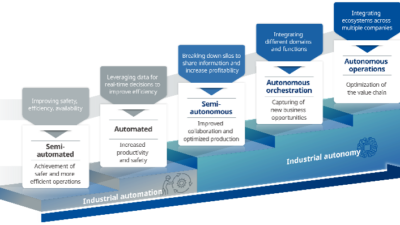
Both guests said the future factory is likely to be more efficient and less reactive, but not necessarily unrecognizable. Dyck pointed to reshoring, labor shortages and productivity demands as reasons manufacturers will need more autonomous or semi-autonomous operations. Harrington said better data access should also mean more organized environments, fewer surprises and less time spent responding to crises after the fact.
“The goal is that it will be more efficient,” he said. “It will be cleaner. There will be fewer people, but it’s not fewer people because we’re stripping people out.”
That vision depends on manufacturers being able to move data where it is needed, with enough context to make it useful.
Interoperability is not the final objective. It is the enabler behind many of the outcomes manufacturers are trying to reach, including faster deployment, enterprise scalability, usable AI and better decisions. For companies still struggling with siloed systems, that may make interoperability one of the most important industrial priorities on the table today.
The Ctrl+Alt+Mfg Podcast
Make sure to check out other episodes of the Ctrl+Alt+Mfg podcast, where hosts Gary Cohen and Stephanie Neil discuss a range of digital transformation insights. The last five episodes are listed below:
Ep. 9: When cyberattacks go physical, with Ian Bramson of Black & Veatch
Ep. 10: Modernization vs. digital transformation, with Dan Furrow and Luis Atencio of Wesco
Ep. 11: What plant engineers really want, with Amara Rozgus of Plant Engineering
Ep. 12: Why system integrators matter more than ever in the age of AI, with Adrienne Meyer of CSIA
Ep. 13: Bad data, broken maintenance, with Paul Ross of Limble and Ross Fergerson of RBC Bearings