From enabling enterprise-wide visibility and evergreen operation to reducing standards compliance gaps, next-generation control technologies are giving manufacturers the tools to operate more efficiently, standardize more easily and stay ahead in a competitive global marketplace.

Next-generation DCS insights
- Today’s distributed control systems are providing more data, wider intelligence and better metrics for greater enterprise visibility.
- Enterprise engineering tools and simulation increase success.
- Today’s control technologies can build a foundation for automation of the future.
Control technology is moving from plant-centric systems into enterprise operations platforms with standards-based automation, simulation pipelines, secure incremental updates and open interface adoption to integrate computational intelligence and deterministic logic. New platforms will address complexities of modern process manufacturing that have increased dramatically in the expanding global marketplace. Today, success is no longer defined by the performance of a flagship plant, it requires sustained efficiency, stable production and consistent quality across every facility.
The industry has crossed a threshold. Addressing obvious inefficiencies inside individual plants no longer yields transformative gains. Organizations are now realizing that achieving the next level of operational excellence means expanding focus to drive improved enterprise-wide optimization.
The organizations accelerating the fastest toward enterprise-wide optimization are those that treat the next-generation distributed control system (DCS) as an enterprise operations platform (EOP): a software-defined control and intelligence ecosystem that spans sites, exposes trusted real-time data, and coordinates deterministic control with predictive and prescriptive analytics.
The EOP strategy for modernization leverages next-generation, software-defined control to deliver seamless integration, enterprise visibility, near limitless scalability, and improved operational excellence. Moreover, because the strategy relies on a comprehensive data fabric, it can be implemented incrementally, helping teams preserve their existing automation investments.
More data, wider intelligence, better metrics
This evolution is not just architectural—it delivers actionable decisions in minutes or seconds instead of days. As an example, consider a coastal chemical plant facing a forecasted 48-hour tropical storm disruption. As the EOP ingests weather and logistics data, it simulates expected throughput loss (such as 12% of monthly ethylene output). Before the storm hits, a sister inland facility automatically receives a recommended ramp profile: increase feed rates by 8% within validated safety and energy envelopes, pre-position catalyst, and adjust steam demand. The platform verifies constraints (flare limits, compressor loading, utility contracts, etc.) via digital twin models, then publishes the approved changes as a versioned control update. The result for the enterprise is that the shortfall is cut from a projected 12% to 3%, all without manual spreadsheet coordination.
Such a scenario demonstrates why it is no longer enough to ensure that each plant operates at its best in isolation. Competitive advantage now depends on optimizing and standardizing every plant in the enterprise to work efficiently and effectively as a seamless, interconnected, and holistic operation.
Chasing enterprise visibility
Organizations have chased enterprise-wide operational improvement for years, but workforce retirements and lean staffing have intensified the urgency. Fewer expert engineers mean companies must capture institutional knowledge, lock in best practices, and manage more assets with less hands-on oversight.
To meet these goals, organizations across every industry have been developing corporate and enterprise standards libraries to provide optimization, reduction of complexity, and consistency of operation. Standards libraries can be an important tool in streamlining operation across the enterprise and more rapidly rolling out best practices as they are discovered. Yet, without strong governance, standards libraries often fail to maintain required consistency across disparate sites.
Manual paper- or spreadsheet-based enforcement is a useful starting point: write the standards, distribute them, and then ask sites to conform. But lean teams quickly hit limitations. Comparing a live configuration between two plants becomes a time-consuming detective exercise, and subtle configuration drift goes unnoticed.
Even when sites adopt the same baseline standards, real-world variability erodes alignment due to local edits to control logic, personnel changes, environmental influences (seasonal temperature or humidity changes), shifts in raw material quality, and other factors. These dynamic factors aren’t captured well in static documents, leading to uneven performance across sites separated by hundreds or thousands of miles.
What organizations need next is a move from static documentation to automated, data-driven standards governance. This approach will provide continuous visibility into deviations, contextual comparison, and a living repository that reflects the approved baseline and controlled, auditable changes over time.
Enterprise engineering tools
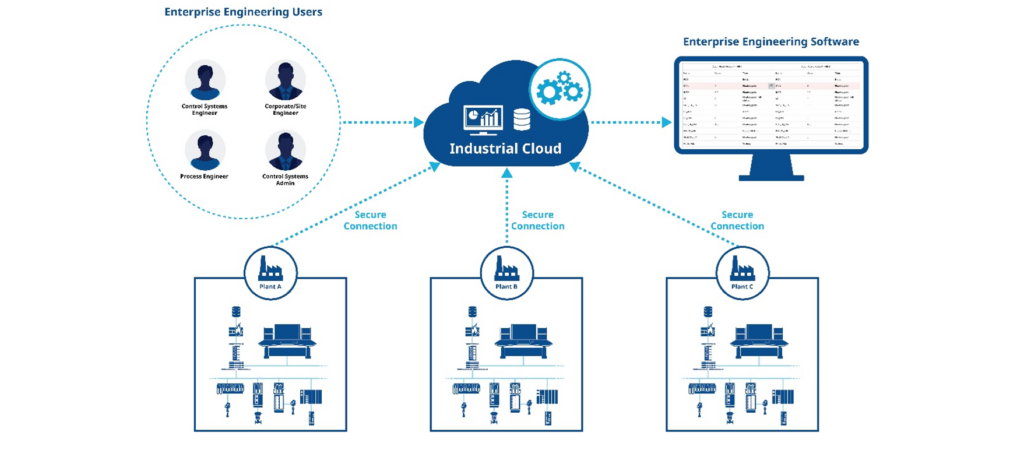
Enterprise engineering software is a foundational element of the emerging EOP. It replaces labor-intensive, manual standards management, with automated, data-driven governance of engineering standards across the enterprise. It visually surfaces configuration differences in the context of the approved control strategy, instead of forcing staff to hunt through spreadsheets or potentially outdated documents (Figure 1).
These tools transmit live and historical system configurations to a secure cloud environment, giving authorized users remote access from any location. Role-based access control presents each user with only the systems and configuration elements in their span of responsibility, reducing noise and tightening security posture.
Staff can log into the cloud application and view the most up-to-date DCS configuration from any system and any site they have permission to access. Exception-based views highlight where a configuration deviates from corporate standards—turning “find the drift” into a targeted review instead of a manual audit. Versioned historical data and version management allow engineers to correlate specific adjustments with shifts in process performance, quality and reliability indicators (Figure 2).
By capturing lessons learned, approved templates, and annotated changes in one common system, enterprise engineering software provides an evergreen, single source of truth for control and engineering standards across the enterprise. This shrinks the time required to propagate a validated improvement from a pilot plant to the rest of the fleet and reduces the risk of undetected divergence. Moreover, as part of an EOP, the software provides data consistency and a common data model and definitions—along with data availability to personnel, artificial intelligence (AI) and machine learning (ML) applications.
Simulation increases success
As organizations establish corporate standards across the enterprise, they will need easier ways to identify, test, and implement new control strategies to further increase operational excellence. Digital twin simulation, fed by a unified data fabric spanning intelligent field devices, the edge, and cloud analytics, enables a “prove-before-you-update” workflow. Teams use the current control configuration as the base model in the simulation, inject candidate logic or ML-derived setpoint strategies and compare predicted key performance indicator (KPI) shifts (energy intensity, yield variance, constraint margin) to determine promotable changes.
Soon, with enterprise engineering software, successful scenarios will advance to a gated deployment pipeline—first shadow mode, then canary release, and finally fleet rollout. The outcome is an enterprise operations environment where teams can run their operations while testing and watching simulated scenarios in parallel, and then seamlessly transition successful new control logic to real-time control, driving the innovation and flexibility necessary to capture competitive advantage.
Easier evergreen operations
A long-term but equally important goal of the EOP is to move away from the control system as a static monolith toward a new paradigm of flexible, evergreen operation. One of the greatest challenges at the intersection of OT/IT convergence has been that the control system has never been as easily updated and patched as traditional IT systems due to the criticality of uptime and stability. Updating and patching the control system often means bringing operations down, and that downtime is costly.
Evergreen operation depends on decoupling control capabilities into independently updateable, containerized services. Core deterministic loops remain hardened while adjacent services—analytics, reliability modules, and visualization adapters—pull updates during defined maintenance windows without forcing unit shutdown.
The emerging EOP seeks to eliminate this barrier to evergreen operation. In fact, existing elements have already begun laying the foundation for more seamless software updates. Today, control system elements like edge environments—where some of the newest and most powerful AI and ML technologies are run—can be updated independently. Reliability solutions and other industrial software can also be updated independently of the control system, helping teams ensure the highest security and access to the most advanced features.
As the automation system moves toward a software-defined, EOP model for the next generation of control, operations teams gain the ability to perform online updates to core control technologies. Containerized workloads with orchestration allow services to run where it makes the most sense—factoring latency, data proximity, cost, and system architecture. This leads to new operating models, empowering teams to perform online upgrades with no downtime by embracing IT infrastructure capabilities within an OT-friendly framework that preserves determinism, while supporting safety and continuous operation.
Building a foundation for automation of the future
The automation system of the future is just that: a future state. While some technologies that will be central to that future are available today, others are years away. However, preparations can start today. Forward-thinking organizations can begin building more enterprise-centric solutions to eliminate much of the need to rip and replace technologies in the future.
As the most advanced automation solutions providers develop new technologies built around an EOP vision, they are increasingly focused on delivering open technologies designed for seamless integration. Choosing technologies built on such a vision helps teams feel more secure that the investments they make today will be ready to meet the new paradigm of operation just over the horizon. These new software-defined, intentionally integrated solutions deliver a fit-for-purpose ecosystem built on a seamless data fabric to prepare for better control across the enterprise.
Ultimately, in the face of a massive paradigm shift, choosing technologies built on a vision for a seamlessly integrated future helps teams continue to evolve their automation technologies—while simultaneously preserving the investments they have already made—a critical strategy for success.
Tomorrow’s foundations; today’s control technologies
There has never been a more exciting time in automation. As control technology evolves from plant-centric systems into EOPs, the organizations that establish a data-centric foundation—standards automation, simulation pipelines, secure incremental updates, and open interface adoption—will reduce lifecycle cost and risk and position themselves to integrate computational intelligence alongside deterministic logic.
Today’s software tools can help teams build capabilities for more supportable enterprise operations, while also paving the way for the next generation control architectures that will define 21st century operations and deliver the immediate competitive advantage necessary in a complex global marketplace. The journey is incremental; the opportunities are exciting.
Brian LaMothe is vice president of applied research and emerging technologies for Emerson’s Process Systems and Solutions business. Edited by Mark T. Hoske, editor-in-chief, Control Engineering, WTWH Media, [email protected].
Keywords
Distributed control systems, DCS, enterprise operations platforms, OEP
Consider this
Is your DCS preparing your facility and enterprise for the future?
You also might like
Lifecycle-ready AI: unlocking value at every stage of process manufacturing