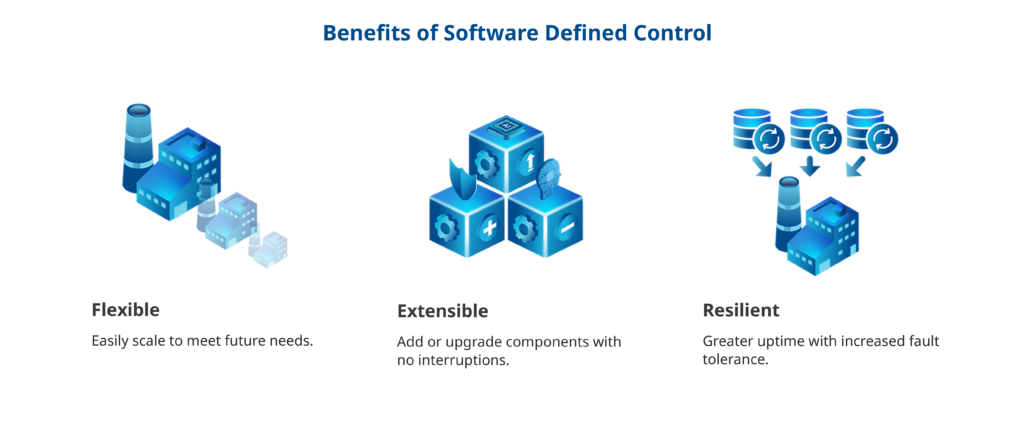
Software-defined control is revolutionizing process manufacturing by enabling the use of server and virtualization technologies to deliver greater computing power, which can be used to provide AI-driven insights, advanced analytics, and improved real-time decision-making. See three benefits graphic.

The distributed control system (DCS) is the heart of any modern continuous and batch process operation, and capabilities of software-defined controls can make next-generation manufacturing smarter, faster and more agile. Providing operators with a fully integrated digital workflow, the DCS has been enhancing productivity and increasing operational efficiency for decades. As plant operations have become more complex, so, too, has the DCS. Engineers have continuously faced the challenge of designing more intricate and interconnected systems to support complex control strategies geared toward increasingly automated—and therefore safer and more efficient—operation.
For years, the controller technology driving DCS operations has been focused on embedded hardware. For many companies embedded hardware was a benefit, as many process operations take place in dirty, dangerous environments. Industrial control hardware was purpose-built to meet those specific needs—designed to handle tough environmental conditions like wide temperature ranges, high vibration, electrical noise, and more. In addition, industrial controllers have long been designed specifically for real-time control purposes, guaranteeing performance, and eliminating the need for additional layers of abstraction that might disrupt operations. The controllers have also become the main gateway to access the OT data generated in the plant floor.
Modern operations, however, have complicated this dynamic. A wide variety of new operational and business requirements have driven a need for a paradigm shift in industrial controller design. More complex operations, shifting plant configurations, and a need for seamless data mobility and flexibility are inspiring process manufacturers to explore a new way of controlling plants via software-defined control.
Traditional DCS design limitations
In recent decades, industrial operations have changed dramatically. The vast majority of end-users locate their controllers in climate-controlled rooms, eliminating the need for the hardened technology that can handle a wide range of environmental conditions. However, the key issue with traditional controllers in safe environments is not simply that the hardware is overdesigned, it also requires tradeoffs. To manage heating issues, industrial controllers rarely make use of the large, multi-core central processing units (CPUs) available today. In fact, to keep temperatures down, they rarely use the full power of the CPUs they have.
Today’s organizations are increasingly pursuing advanced operational strategies such as simulation, advanced process control, analytics, and artificial intelligence (AI) to improve their operations. Modern technology solutions require more computational power than is available with a traditional controller.
While operations teams can increase their compute capabilities by adding additional controllers, that is not always easy. Adding additional controllers typically takes up a great deal of space, and requires a lot of complex engineering, which limits the flexibility and stability of operations.
Evolving needs, changing automation
Modern technologies and a constantly changing automation environment have inspired a wide array of new options for operational capabilities. Consider, for example, a new way of driving more value from engineering simulation. In nearly every plant, engineering models are developed by process engineers to fully prepare and validate the processes of a new plant. Engineers adjust and investigate every part of those models so they know process equipment, like reactors and heat exchangers, inside and out and know with confidence that the chemistry and thermodynamics of the process work.
Process engineering and modeling software is very compute intensive. As a result, engineering teams run the software on very powerful hardware external to the controller. Imagine, however, if operations teams could also run that model directly on the controller to help optimize the plant in real time. If users could run process models on the controller, the control system could continually be checking the live process against the model, providing increased visibility into reliability, sustainability, and performance. In fact, the right combination of simulation, real-time data collection, and analytics technologies running on the controller could possibly even predict outcomes by calculating potential future states.
Such opportunities are only the beginning. With the rise of AI comes the potential for analytics at the edge to augment process control algorithms that will entirely redefine flexible, efficient, and sustainable operations. But none of those capabilities are possible within the limitations of traditional automation architectures. They will require a new framework: software-defined control.
A software-defined vision, real benefits
Software-defined controllers benefit from real-time virtualization to provide the necessary compute power for both real-time control and advanced operational software. Because software-defined controllers do not have the limitations of hardened technology, they can provide more functionality than their embedded technology counterparts, taking full advantage of server technology and scaling more easily to provide features traditional hardware never could (Figure 1 shows hardware versus software defined control).
The systems are more robust, combining both redundancy and fault tolerance mechanisms to help secure continuous operation. Operations teams can upgrade one server while all the controllers run on another server. When the upgrade is complete, the team can shift controllers back to the updated server and update the other server—all of which can be done automatically with the assistance provided by modern workload orchestration. The same technology also allows for automatic failover to a working system if a controller were ever to fail. A software-defined controller can be located in local areas and/or remote areas, providing additional redundancy and flexibility of installation without increased complexity of engineering.
Most exciting, however, is that a software-defined platform allows compute-intensive algorithms like AI and neural networks to run directly on the same server cluster. A software-defined controller can handle more I/O, more function blocks, increased computation, and more, providing better operational efficiency through optimizations that cannot be accomplished with traditional control technology.
In fact, software-defined controllers can run analytics locally, serving as a stepping-stone to more complex analytics that run in the cloud. The controller can provide the first level of data cleaning and analytics—delivering insights right at the edge—and then use the results to send only the required data to business analytics systems at the enterprise, reducing cloud data costs.
Software-defined control also eliminates the need to rip and replace an entire control system to improve operations. The best software-defined controllers can be dropped in alongside traditional control technologies, seamlessly integrating to provide new capabilities without a complete overhaul. And because software-defined controllers run in a virtual environment that can be easily scaled, they provide operations teams with the ability to start small with pilot projects for new technologies because they can easily scale up and out when proven successful (Figure 2 shows three benefits of software-defined control).
A new era for control using software-defined control
As organizations continue to move toward a boundless automation vision for seamless data mobility from field to edge to cloud, built on a unifying data fabric that will support more advanced automation driven by AI and analytics, the need for computing power in the plant will increase dramatically.
Software-defined control will provide answers to these challenges by driving a faster pace of innovation to unlock capabilities via a virtualized environment that is more robust, simpler to engineer, and easier to deploy and scale. An exciting technological future is just over the horizon, supported by a new vision for control.
Claudio Fayad serves as chief technology officer of Emerson’s Aspen Technology business. Edited by Mark T. Hoske, editor-in-chief, Control Engineering, WTWH Media, [email protected].
Keywords
Software-defined control, DCS modernization
Consider this
Are you using control hardware and software that enable smarter, faster and more agile manufacturing?
You also might like
Also from Control Engineering, see:
How to incorporate AI into process manufacturing
Modernize, easily integrate the industrial automation technology stack