Control Engineering offers an hour of webcast instruction on how “Control system integrator advice maximizes automation investments” on Feb. 24, and this article offers more answers on related topics.
More answers for control system integration project ROI insights
- Explore how to maximize automation control system integration investments from system integrators experts, also instructors in a Feb. 24, 2026, Control Engineering webcast.
- Understand how to improve return on investments in automation projects as the instructors answer more audience questions below.
- See the webcast for more advice: Register for the Control Engineering webcast, “Control system integrator advice maximizes automation investments,” archived until Feb. 24, 2027.
More answers are available on automation project returning on investment (ROI). Those attending the following webcast live had additional questions for the instructors about automation project return on investment (ROI). Learn how “Control system integrator advice maximizes automation investments,” the Control Engineering Feb. 24 webcast is archived for a year.
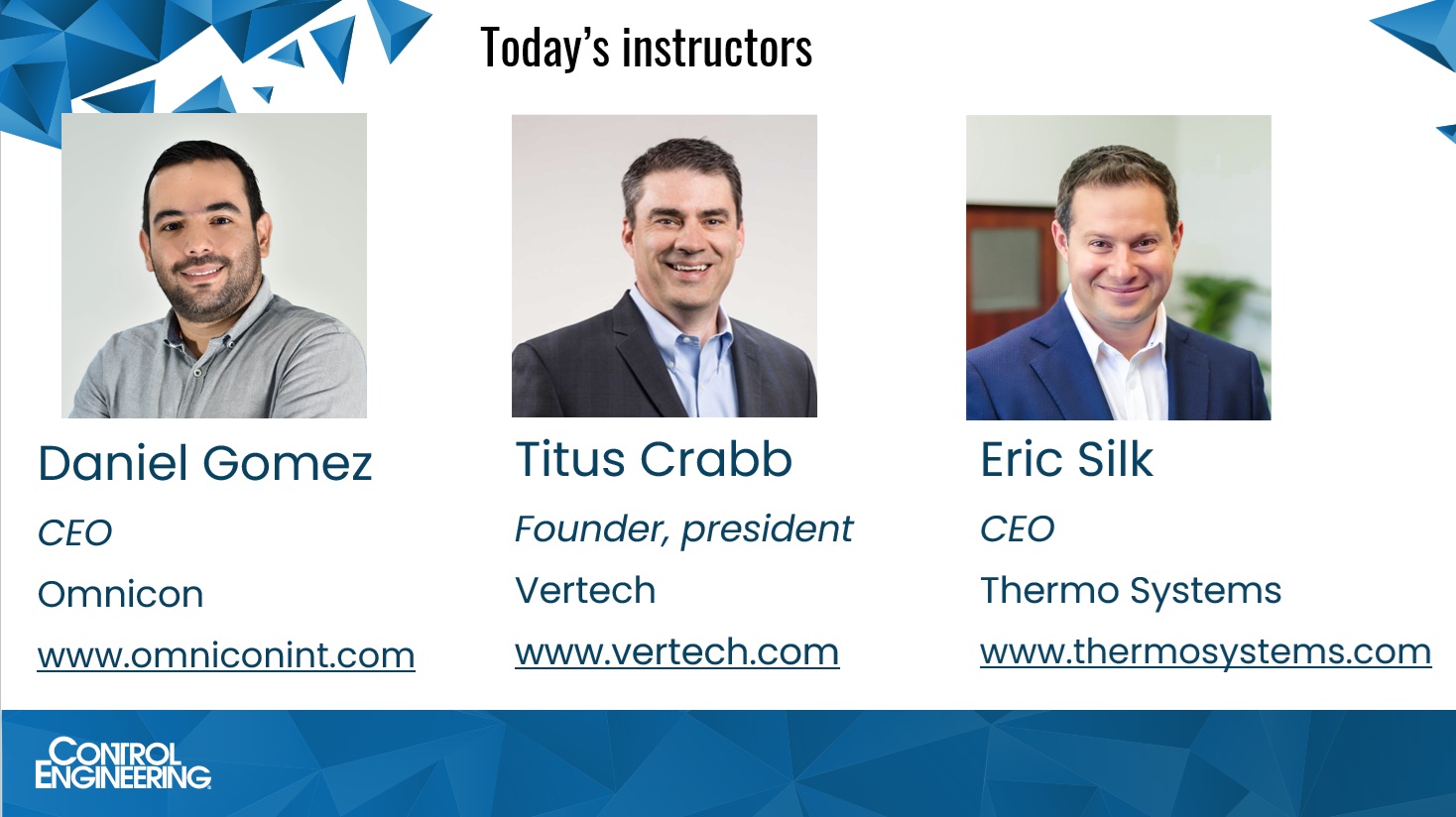
The instructors (Figure 1) are from the three System Integrator of the Year winners for 2026:
- Daniel Gomez is the CEO of Omnicon. With a strong background in operations and strategic management, he leads the company’s global mission of delivering world-class industrial automation and digital solutions. He specializes in driving organizational growth and fostering a culture of innovation, ensuring that Omnicon remains at the forefront of the digital transformation era.
- Titus Crabb is Vertech founder and president, an industrial systems integration firm specializing in automation, supervisory control and data acquisition (SCADA), manufacturing execution systems (MES) and industrial networking. He earned a Bachelor of Science in Electrical Engineering from LeTourneau University in 1993 and founded Vertech in 2004. He has combined engineering, business strategy and team development to deliver world-class technical solutions, with success for clients, employees and partners. Crabb is a scuba diver, Arizona desert hiker and science fiction enthusiast.
- Eric Silk, CEO of Thermo Systems, has more than 17 years of success, starting as a control systems engineer, mastering business skills and transitioning to a sales leadership role in 2016, adding technical and business expertise. As CEO, Silk brings strategic insights and a culture of collaboration and achievement. With commitment to excellence and customer satisfaction he emphasizes innovation, profitability and industry leadership.
Moderator for the webcast is Mark T. Hoske, editor-in-chief, Control Engineering.
More answers from audience questions on industrial automation project investments
Crabb and Silk provided more answers to the following audience questions, below, covering topics including distributed control system (DCS) migration, artificial intelligence (AI) integration and automation project lifecycle planning.
How do I optimize return on investment for DCS migration projects?
Silk: Tie the migration to business outcomes (uptime, safety, compliance, maintainability), engage early to lock scope and cutover strategy, and use a repeatable delivery method with strong planning for factory acceptance test and site acceptance tests (FAT/SAT) planning. Capture additional ROI by assessing which field assets can be safely reused (instrumentation, wiring, panels) to reduce rework and downtime exposure.
How do you accelerate ROI and what processes do you use to help keep projects aligned with objectives?
Crabb: For any project that can reasonably support it, use a “build small then iterate” approach. The initial build should demonstrate real value and provide the foundation for incremental value-adds. Spread each increment around to different stakeholders to increase buy-in. This prevents build-out of scopes that seemed good on paper but don’t benefit anyone, by always prioritizing the next feature-add as the highest value-add. It also provides time for users to adapt and adopt the system and increases long-term buy-in.
Silk: Accelerate ROI by aligning on success criteria up front, applying disciplined scope and standards governance and by managing change tightly. Continuous stakeholder alignment, lifecycle planning and structured testing keep execution predictable and prevent late rework.
How is industrial AI expansion reshaping integration scopes, barriers, project timelines and commissioning?
Silk: AI expands scope from controls into data readiness, connectivity, cybersecurity and alignment of information technology and operational technology (IT/OT) efforts alignment. It can add early-phase planning, but standardized architectures, piloted rollouts and commissioning plans that validate data paths and security reduce startup risk and speed time to value.
How do you see AI and machine learning (ML) in the projects you provide—both as tools you use and as part of the end user’s business objectives?
Silk: Use AI/ML in two layers: internally to improve delivery discipline and predictability, and externally as an optimization layer on top of proven controls/data foundations—focused on measurable outcomes like reliability, efficiency and predictive insight.
What are some customer trends changing automation and control system integration projects?
Silk: Customers want lifecycle outcomes (scalability, security, maintainability), open and interoperable architectures and phased/low‑disruption delivery. They also expect stronger integration across controls, networks, data and cybersecurity—plus ongoing support after commissioning.
Crabb: Customers are getting more serious about deriving real value from their plant-floor data. Automation projects see requirements not just for connectivity like OPC UA (from OPC Foundation), but for out-of-the-box data availability to support plant efficiency and optimization efforts across functions like maintenance, inventory management, production scheduling and other areas.
When deciding what automation components to use, such as servo motors or motion controllers, what criteria do you prioritize?
Silk: Prioritize fit to the application and lifecycle risk with reliability, integration with the overall architecture, standardization, vendor lifecycle support, maintainability and cybersecurity implications—so the solution stays supportable well beyond startup.
Are you seeing or helping to draft more requests for proposals with automation interoperability requirements? Why or why not?
Silk: Yes. Interoperability is increasingly explicit to avoid vendor lock‑in, integrate legacy with new platforms and support future analytics and cybersecurity initiatives. Strong requests for proposals (RFPs) translate this into clear interface definitions, standards and testable acceptance criteria.
What are the most overlooked considerations in automation lifecycle planning?
Silk: Often overlooked are ownership boundaries, documentation quality, training, backup/version control, cybersecurity sustainment and upgrade pathways. Neglecting these early increases troubleshooting time, outage risk and total lifecycle cost.
In my project management experience, I learned to begin with maintenance in mind. How do you get customers to understand the costs of not planning early for system maintenance?
Crabb: Great question. This horse has been led to water so many times. [Planning for maintenance in automation projects] requires proactive direction from those establishing requirements and budgets. If maintenance needs are not in the scope, they won’t be included in the design and project delivery.
Silk: Make lifecycle impacts tangible by showing how design choices affect spares, downtime, troubleshooting time, training burden and future upgrades. Emphasize that late changes during commissioning/operations cost more and disrupt uptime—so maintenance planning is a risk‑reduction investment.
Can feature migration planning during the project phase minimize risk to operational availability periods?
Silk: To plan feature migration as staged cohorts, classify features by operational criticality, validate in test environments, deploy in low‑impact windows and maintain rollback options. Sequencing by risk and business impact modernizes capabilities while protecting availability.
What is 5D methodology?
Silk: A structured integration approach requires that participants define, design, develop, demonstrate and deliver. It “left‑shifts” risk by clarifying requirements early, proving solutions through testing/demonstration, and then delivering with predictable commissioning and handoff.
Crabb: The Define, Design, Develop, Demonstrate (test), Deliver process is just a branding term to describe a systematic approach to problem solving.
If I want a contractor to perform SCADA integration with limited input from me as the end user, what’s a good place to draw the line between their responsibilities and mine?
Crabb: Define the scope in terms of outcomes. Describe the functionality. Provide any standards you require like screen layouts and color schemes, data structures and naming conventions, etc. Work with the integrator to develop a review cadence that regularly makes minor course-corrections. The more input you want on methods, structure, aesthetics, the more of your time the project will require. If you have the freedom to stay outcome-focused, you just need a few quality review gates along the way.
Silk: Create a clean boundary. The owner provides site readiness (network/connectivity, access approvals, cybersecurity requirements, operational constraints). The contractor owns SCADA configuration, integration, testing, documentation and training once the connection is available.
When electrical, instrumentation and control design is fragmented across vendors, what works best to combine your talents and capabilities for the customer benefit?
Crabb: Standards are a common way to approach this, but getting various vendors to conform to your standards is challenging and expensive. Another approach is to let vendors provide their standard package and then use one provider to build a unified SCADA layer to provide a common visualization and reporting system connecting the disparate systems.
Silk: Assign one integrator to govern standards, interfaces and end‑to‑end testing, so each vendor can focus on strengths while the system is delivered as one cohesive solution.
Within a distributed enterprise with mixed legacy and next‑generation programmable logic controller (PLC) platforms, how would you establish unified controls governance while preserving site autonomy and minimizing risk?
Silk: Set enterprise guardrails (cyber posture, segmentation, redundancy, interface standards), standardize proven reference patterns, and modernize in controlled cohorts. Use an approved deviation process to preserve site autonomy and reinforce lifecycle asset visibility (documentation, backups/versioning, upgrade roadmaps) to reduce process risk.
The Feb. 24 webcast provides additional automation advice and examples with graphics. See link below.
Mark T. Hoske is editor-in-chief, Control Engineering, WTWH Media, [email protected].
Keywords
Automation ROI answers, Industrial automation optimization, control system integration, automation integration, automation ROI
Consider this
Are you getting the return on investment expected from automation projects?
You also might like
Register for the Control Engineering webcast, “Control system integrator advice maximizes automation investments,” archived until Feb. 24, 2027.